

Choosing an Elliott Wave Course: What Actually Matters
If you are looking for an Elliott Wave course, you have probably already found the problem. There are dozens of them, they all promise the same things, and most of the free material contradicts itself. Half of what circulates online gets the basic rules wrong.
This post covers what separates a good Elliott Wave course from a bad one, the three things most of them skip, and the one I took myself and now recommend.
What you are actually trying to learn
Elliott Wave is not a prediction system. It is a way of describing the shape of price movement.
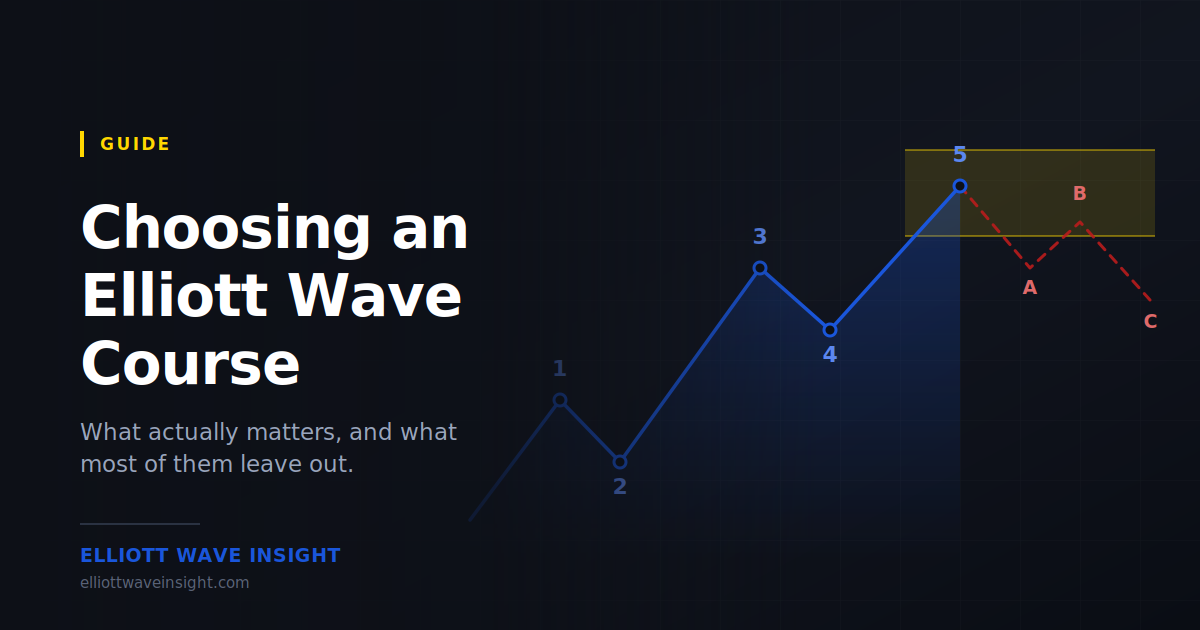
The core observation is that markets move in recognisable patterns that repeat at every scale. Trending moves subdivide into five waves. Corrections subdivide into three. Those corrections come in a handful of named forms: zigzags, flats, triangles, and combinations of those joined together. A five-wave advance on a one-minute chart has the same structure as one spanning forty years.
That is the whole framework. Everything else is detail about telling one pattern from another and knowing what each implies about what comes next.
The value is not that it gives you targets. It is that it tells you when you are wrong. A valid count comes with rules attached, and when price breaks one of them the count is dead and you know immediately. That is worth more than a price projection.
Three things most Elliott Wave courses skip
Free videos and cheap courses cover impulses well enough. Here is where they run out.
Degree
Every wave sits inside a larger wave and contains smaller ones. Getting the degree wrong is the most common error in the whole framework, and it propagates: label a structure one level too high and everything nested inside it is wrong too.
Most beginners assign degree from the bottom up, which almost guarantees a rebuild when they zoom out. A course worth paying for teaches you to anchor from the largest visible structure and count down, and gives you the typical duration for each degree so you can sanity-check what you have labelled.
The rules are not guidelines
Wave two cannot retrace beyond the start of wave one. Wave three cannot be the shortest of waves one, three and five. Wave four cannot enter wave one’s price territory, unless the structure is a diagonal, in which case it must.
These are hard constraints. A count that breaks one is not a weak count, it is not a count at all. A surprising amount of published wave analysis quietly ignores this, which is why so much of it is unfalsifiable.
Corrections
Impulses are straightforward. Corrections are where most of your chart time goes and where nearly all the mistakes happen.
The difference between a running flat and an expanded flat changes what you expect next. A double three looks like noise until you can see the three separate structures inside it. Triangles appear in specific positions and nowhere else, and knowing which positions is half the value of spotting one.
Any Elliott Wave course that spends most of its time on impulses is teaching you the easy quarter of the subject.
The Elliott Wave course we recommend
I took Mudassar’s Elliott Wave Principle on Udemy myself, and it is the one I point people to.
It runs to roughly 16 hours across 47 lectures, rated 4.6 by more than 7,000 learners. What makes it worth the time is that it covers all three of the gaps above rather than just the first quarter.
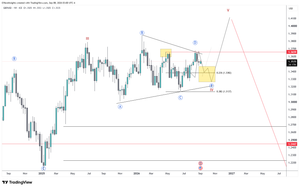
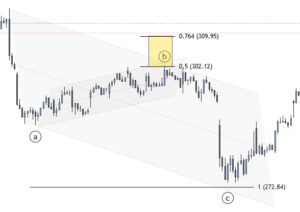
On corrections, it works through regular and expanded flats, running flats, contracting and expanding triangles, barrier and running triangles, single, double and triple zigzags, and combinations. Each one gets a real chart example rather than an idealised diagram, which matters because textbook patterns and market patterns look different.
On validity, it covers the rules and labelling conventions, position of patterns, alternation, extension and truncation, channelling and wave equality, and what he calls the right look, which is the judgement about whether a structure is proportioned correctly. That last one is the hardest thing to teach and the thing that separates a count from a guess.
On application, there is a section combining wave counts with RSI, which matters because momentum is one of the few independent checks on whether a fifth wave is genuinely terminal. And there is a live trading sequence taking a NASDAQ position through analysis, entry, trailing stops and exit, which shows the decision-making between having a count and placing a trade.
The course includes downloadable resources and assignments where you label charts yourself. That part is not optional. You do not learn this by watching.
What no Elliott Wave course will do
It will not make you profitable. None of them will, and any course claiming otherwise is selling something other than education.
Wave counting will not tell you what size to trade, how to place a stop relative to your account rather than the chart, or how to stop yourself re-entering a losing idea four times in twenty minutes. Those are separate disciplines and they cost people far more money than bad counts do.
What the framework gives you is a structure for thinking about price, a clear definition of when you are wrong, and market context that is more useful than most alternatives. That is a genuine edge. It is not a complete one, and anyone telling you otherwise is not being straight with you.
Where to go next
Learn the framework first. Then read published analysis with the labels making sense to you instead of washing over you.
If you already know the basics and would rather have the counts than do the work yourself, that is what our membership covers. The free tier gives you summaries and charts as they publish, which is a reasonable way to see whether the approach suits how you think before paying for anything.
Disclosure: Elliott Wave Insight is an affiliate partner. We may earn a commission if you purchase through the link above, at no extra cost to you. Trading involves substantial risk of loss and is not suitable for everyone. Nothing in this post is a recommendation to buy or sell any instrument.
Join the discussion