

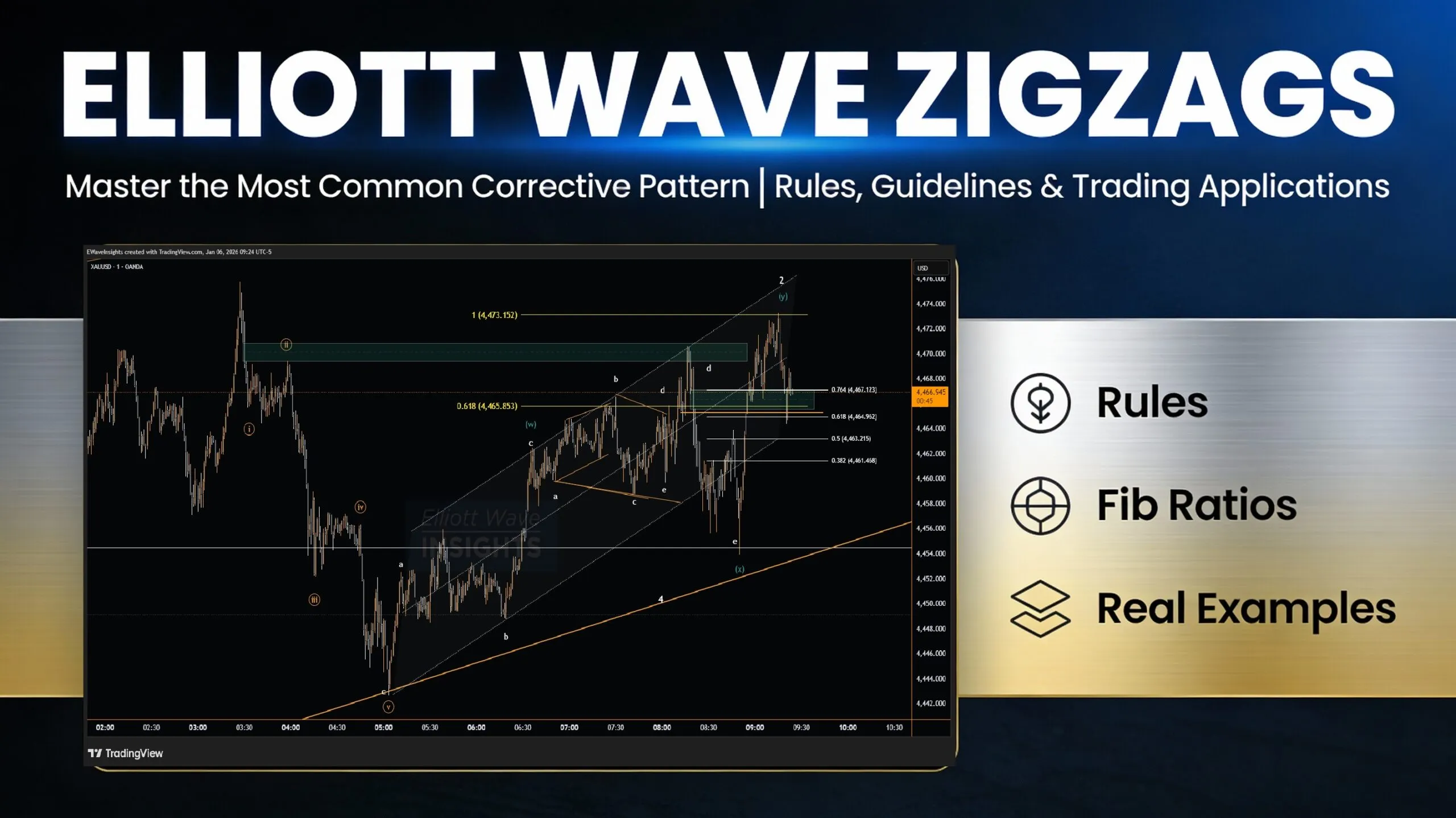
ELLIOTT WAVE ZIGZAGS: Complete Guide & Fib Relationships
Elliott Wave Zigzags: Complete Guide & Fib Relationships
Master the Most Common Corrective Pattern · Rules, Guidelines & Trading Applications
What is a Zigzag?
A zigzag is one of the most common Elliott Wave corrective patterns. It consists of three waves (A-B-C) that move sharply against the larger trend, creating a distinctive “Z” shape on the chart. Zigzags are highly directional reversals with clear structure and reliable Fibonacci targets, making them essential for traders to identify and trade.
Zigzag Structure: A-B-C Breakdown
| Wave | Structure | Direction | Characteristic |
|---|---|---|---|
| Wave A | 5-wave impulse (or 3-wave) | Against trend | Sharp, decisive move down (or up) |
| Wave B | 3-wave correction (any type) | Against Wave A (bounce) | Retraces 50%–79.6% of Wave A |
| Wave C | 5-wave impulse | Same as Wave A | Sharp move, often extends 1.236–1.618 of Wave A |
Official Zigzag Rules
Rule 1: Wave A Structure
✅ Wave A MUST be a 5-wave impulse (or 3-wave in rare cases)
✅ ALWAYS moves OPPOSITE to the preceding trend
✅ Cannot overlap Wave 4 of the preceding impulse
Rule 2: Wave B Retracement
✅ MUST be a 3-wave corrective structure
✅ Retraces 50–79.6% of Wave A
❌ CANNOT retrace more than 100% of Wave A
Rule 3: Wave C Structure
✅ MUST be a 5-wave impulse
✅ Typically reaches 61.8–100% of Wave A
✅ Can extend to 123.6% or 161.8% of Wave A
Rule 4: Zigzag as a Whole
✅ 7-swing structure (5+3+5)
✅ Retraces 50–79.6% of the preceding impulse
✅ Occurs in positions 2, 4, A, or B of larger structures
Fibonacci Relationships in Zigzags
Wave B Retracement of Wave A
| Fib Level | Typical Range | Frequency | Notes |
|---|---|---|---|
| 50% | Shallow retrace | 20% | Less common, indicates strength |
| 61.8% | MOST COMMON | 60% | Golden ratio – target this first |
| 76.4% | Deeper retrace | 15% | Still valid zigzag |
| 79.6% | Maximum valid | 5% | At limit – deeper = not a zigzag |
Wave C Extent Compared to Wave A
| Fib Ratio | Wave C Size | Frequency | Trading Implication |
|---|---|---|---|
| 0.618 of A | Shorter C | 15% | Weak zigzag – trend resuming |
| 1.0 of A | EQUAL WAVES | 50% | Most balanced – primary target |
| 1.236 of A | Extended C | 25% | Aggressive downside – deep correction |
| 1.618 of A | Extreme C | 10% | Panic selling/buying – violent moves |
Types of Zigzags
1. Standard (Most Common)
Structure: A (5) → B (61.8%) → C (100% of A)
Frequency: 50%
Trading: Most reliable, easy to trade
2. Extended (Aggressive)
Structure: A (5) → B (shallow) → C (1.236–1.618 of A)
Frequency: 25%
Trading: More profit, higher risk
3. Truncated (Weak)
Structure: A (5) → B (3) → C (0.618 of A only)
Frequency: 15%
Trading: Weak – trend resuming quickly
4. Double/Triple (Complex)
Structure: W → X → Y [→ X → Z]
Frequency: 10%
Trading: Multiple entry points, takes longer
Trading Zigzag Patterns
Setup 1: Anticipate Wave C From Wave B High
After Wave B completes, set sell orders at 100% or 123.6% of Wave A extension from Wave B start.
| Wave B retrace | 61.8% of A |
| Entry | At Wave B high, anticipating C wave down |
| Target C | 100% or 123.6% of Wave A extent |
| Risk | Above Wave B high (invalidation) |
Setup 2: Trade the Wave C Breakout
After Wave C completes, trade the trend resumption above Wave A high.
| Confirmation | Close above Wave A high = zigzag complete |
| Entry | BUY break above Wave A high + pullback |
| Target | Wave 1 of new impulse |
| Stop | Below Wave C low |
Setup 3: Wave B Bounce Trade
Trade the bounce from Wave A low up to the 61.8% retracement.
| Entry | At Wave A low (start of Wave B) |
| Target | 61.8% of Wave A (Wave B expected high) |
| Stop | Below Wave A low |
| Duration | Quick 1–3 day trade |
Zigzag Identification Checklist
- Does Wave A have 5-wave subdivision?
- Is Wave A moving AGAINST the larger trend?
- Does Wave B retrace 50–79.6% of Wave A? (61.8% most common)
- Is Wave B a 3-wave structure (ABC)?
- Does Wave C have 5-wave impulse structure?
- Is Wave C moving in the same direction as Wave A?
- Does Wave C reach 61.8–161.8% of Wave A (typically 100%)?
- Does the whole zigzag retrace 50–79.6% of the prior impulse?
- After completion, does price break above Wave A high?
- No overlap violations between waves
Common Zigzag Mistakes to Avoid
❌ Mistake 1: Calling a Wave B retrace >79.6% a zigzag.
✓ Fix: If B retraces >79.6%, it’s likely a flat or other corrective structure.
❌ Mistake 2: Forcing a 3-wave pattern into a zigzag.
✓ Fix: Wave A MUST have 5 waves. 3-wave A = NOT a zigzag.
❌ Mistake 3: Entering Wave C before Wave B is confirmed.
✓ Fix: Wait for Wave B to hit the Fib level before shorting.
❌ Mistake 4: Using Wave A as the only Wave C target.
✓ Fix: Wave C often extends to 1.236–1.618× Wave A.
❌ Mistake 5: Dismissing a pattern because Wave B looks “too big.”
✓ Fix: Wave B can retrace 50–79.6% – trust the math, not the eye.
Real Example: XAUUSD Zigzag
Gold completes Wave 5 of impulse at 4,800, then enters Wave 2 correction.
| Wave | Structure | Price Level | Fib Notes |
|---|---|---|---|
| Wave A Down | 5-wave impulse | 4,800 → 4,500 (300 pips) | Sharp down |
| Wave B Up | 3-wave bounce | 4,500 → 4,685 (185 pips) | 61.8% of 300p = 185p ✓ |
| Wave C Down | 5-wave impulse | 4,685 → 4,415 (270 pips) | 90% of Wave A ✓ |
Trade Plan
1. SHORT at 4,685 (Wave B high)
2. Target: 4,415 (100% of Wave A from 4,685)
3. Stop: 4,750 (above Wave B high)
4. R/R: 270 pips / 65 pips = 4:1 ✓
W-X-Y Correction Structure
| Wave Component | Wave Structure | Trading Implication |
|---|---|---|
| Wave W | 5-wave corrective pattern (down) | Initial correction – establishes support |
| Wave X | 3-wave countertrend (up) | Connecting bounce – more correction ahead |
| Wave Y | 5-wave or complex (down) | Final target – deeper than Wave W alone |
Quick Reference: Zigzag Essentials
- Structure: A (5 waves) → B (3 waves, 61.8% retrace) → C (5 waves, 100% of A)
- Best Fib Levels: Wave B = 61.8% of A | Wave C = 100–123.6% of A
- Whole Zigzag Retrace: 50–79.6% of prior impulse
- Frequency: 50% standard · 25% extended · 15% truncated · 10% complex
- Most Reliable Trade: Wait for Wave B 61.8% retrace, then short Wave C
- Key Rule: Wave B >79.6% = NOT a zigzag. Reassess the pattern.
Join the discussion