Elliott Wave Insight · September 14, 2026 · 15 min read
Fibonacci retracement levels should be drawn on the most recent, clear impulse leg and confirmed with additional signals before entering a trade.
The 50% and 61.8% levels, known as the Golden Zone, are the most significant zones for potential reversals, especially when supported by volume or moving averages.
Using multiple confirmation factors, such as candlestick patterns or volume spikes, greatly increases the reliability of Fibonacci levels as entry triggers.
Traders should avoid subjective anchor points, overlapping levels, or multiple timeframes, which can lead to false signals and unreliable setups.
Fibonacci extensions help set profit targets, with the 161.8% level being the typical goal in strong trends, while stops should be placed beyond the next Fibonacci level or using ATR-based buffers.
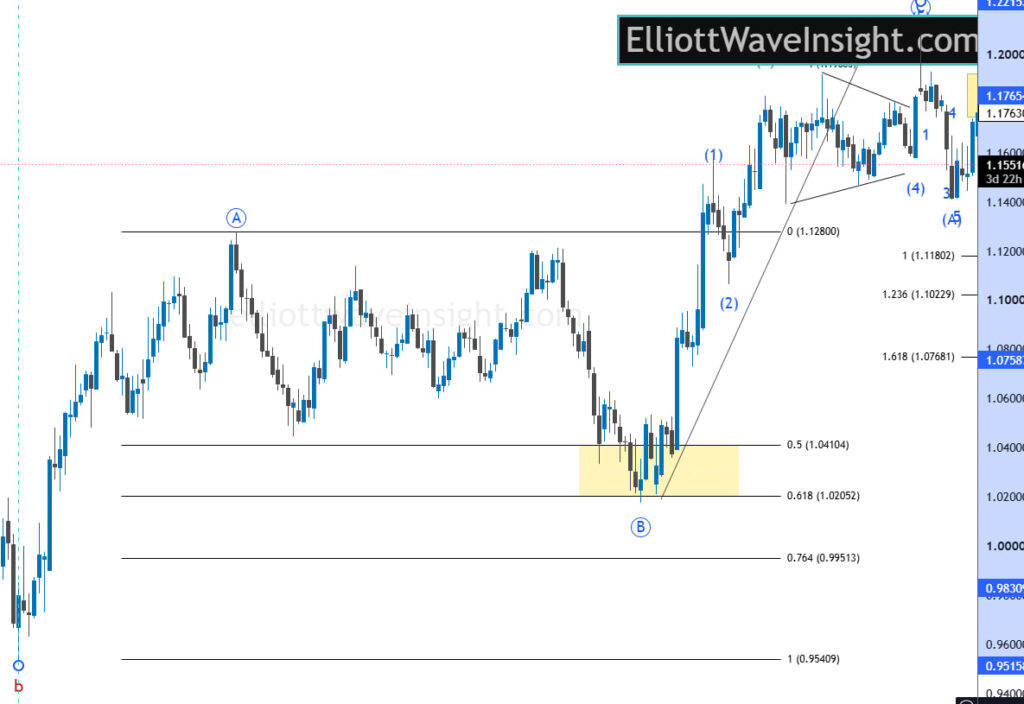
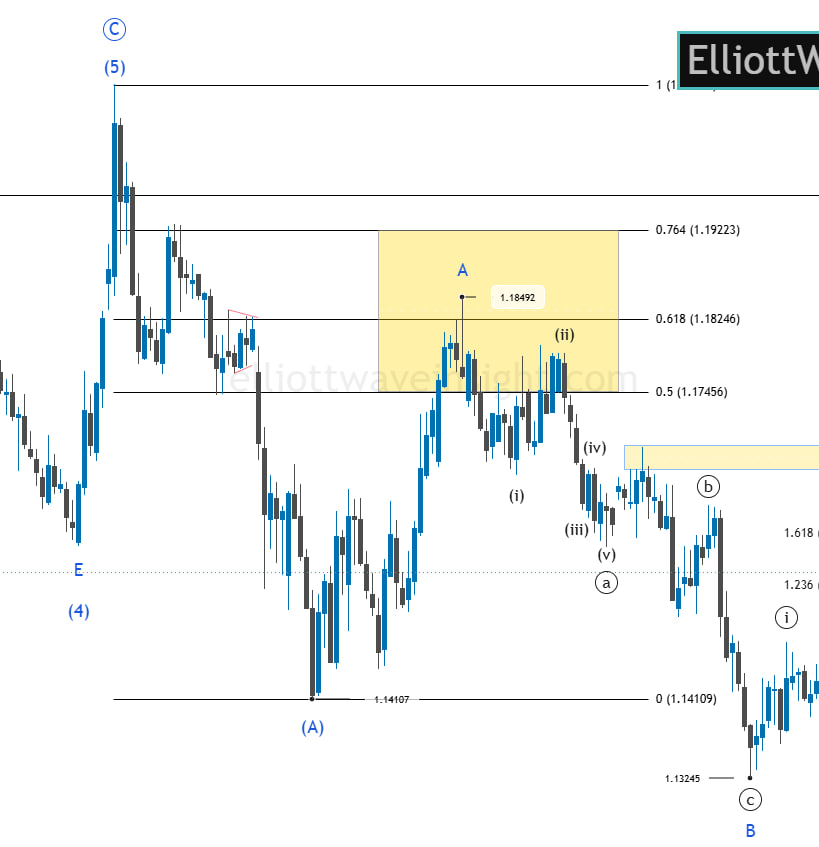
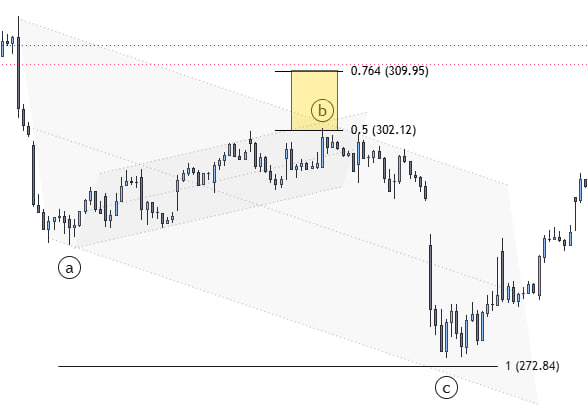
EURUSD bottoms at wave B inside the 0.5 to 0.618 Golden Zone before launching a five-wave rally, the Golden Zone doing exactly what it’s supposed to.
What Fibonacci Retracement Levels Are and Why Traders Use Them
Fibonacci retracement levels come from a sequence you already know from grade school math: 0, 1, 1, 2, 3, 5, 8, 13, 21, and so on, where each number is the sum of the two before it. Divide most numbers in that sequence by the one two places to the right, and you consistently land near 0.618, the golden ratio. Traders didn’t invent this pattern. They borrowed it from architecture and nature, where the same ratio shows up in nautilus shells and Renaissance paintings, and applied it to price charts because markets, like most things driven by crowd behavior, tend to retrace in proportional chunks rather than random ones.
The tool plots those ratios between a swing high and a swing low, creating horizontal lines where price has a statistical tendency to react. According to Wikipedia’s overview of the technique, the most commonly watched levels are 23.6%, 38.2%, 50%, 61.8%, and 78.6%. Here’s what each one typically signals:
23.6%. A shallow pullback, common in strong trends where buyers or sellers barely pause before continuing.
38.2%. A moderate retracement, often the first real test of trend strength.
50%. Not technically a Fibonacci ratio at all, but a widely watched psychological midpoint. Investing notes that traders include it anyway because half-of-the-move behavior shows up so often in practice.
61.8%. The golden ratio itself, and historically the deepest level trends tend to hold before losing structure.
78.6%. A steep retracement that signals the trend may be in trouble, though it can still hold in volatile assets like crypto or small caps.
The zone between 50% and 61.8% gets its own name in trading circles: the Golden Zone. Case studies from outlets like FXEmpire repeatedly show this band acting as a high-probability re-entry area when confirmed by price action and volume, which is why it earns more attention than any single line on the chart.
Why do these levels work at all? Partly math, partly psychology. Enough traders, institutions, and algorithms watch the same ratios that the levels become somewhat self-fulfilling. When a large enough crowd expects support at 61.8%, buy orders cluster there, and the level holds because people believed it would. That’s not mysticism. It’s crowd behavior with a mathematical label attached.
How to Draw Fibonacci Retracement Levels Correctly
Bad anchor selection ruins more Fibonacci setups than any other mistake. The tool is only as good as the two points you choose, and getting this step wrong makes every level downstream meaningless.
Start with vocabulary. An impulse leg is a clean, directional price move, the kind of thrust that defines a trend. The swing high and swing low are the extreme points of that leg, the top and bottom of the move you’re measuring. Everything else follows from correctly identifying these three things.
Here’s the process:
Choose your timeframe first. Decide whether you’re trading off the daily, 4-hour, or 1-hour chart before you touch the drawing tool. Retracements drawn on mismatched timeframes produce conflicting levels that confuse more than they clarify.
Identify the dominant impulse leg. Look for the most recent clear, uninterrupted move in the direction of the trend, not a minor squiggle inside a larger consolidation. Investing.com’s step-by-step guide makes the point that correct anchor selection is the single biggest driver of a retracement tool’s usefulness.
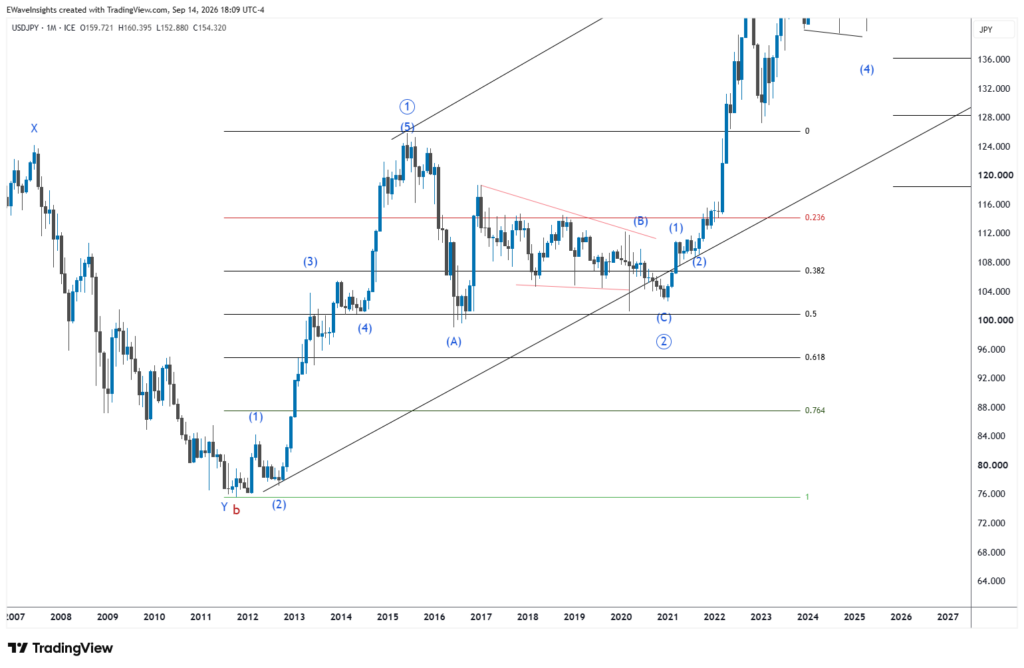
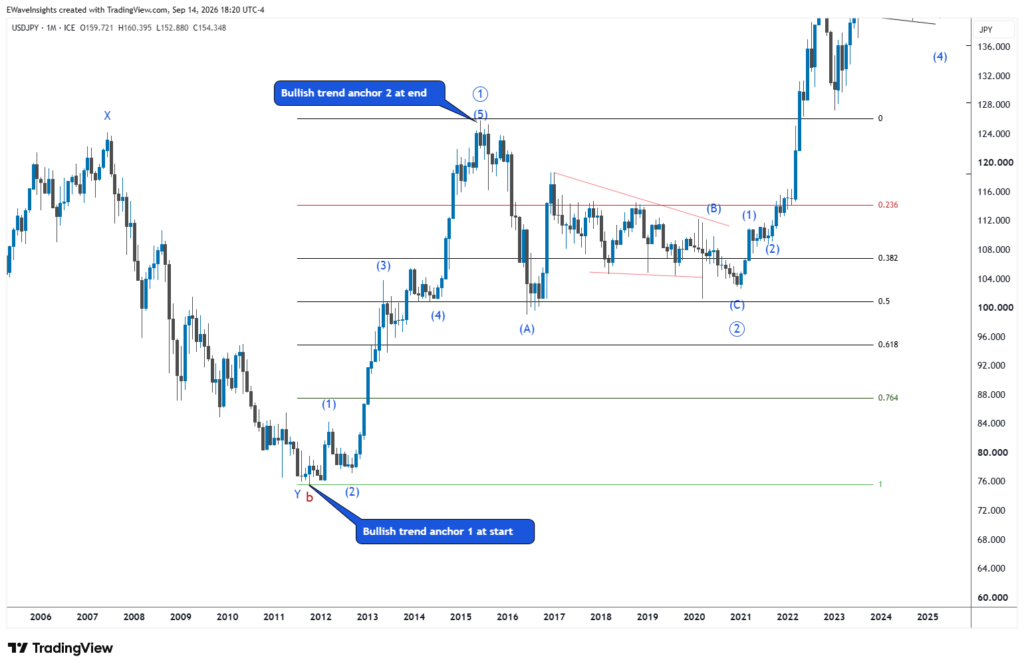
Anchor 0% and 100% at the extremes. In an uptrend, click the swing low first (0%) and drag to the swing high (100%), and the tool will then plot pullback zones below the high. In a downtrend, reverse it: anchor 0% at the swing high and 100% at the swing low, projecting levels above the low.
Anchoring to the full impulse leg versus a minor swing inside it, only one produces a retracement worth trusting.
Before you trust the lines you’ve drawn, run through this quick validation checklist:
Does the impulse leg represent the most recent, most obvious trend move on your chosen timeframe?
Are you anchoring to the actual extreme wick or candle body, not an arbitrary nearby point?
Would a second trader looking at the same chart draw the same two anchor points?
Does the retracement zone line up with any visible prior support or resistance?
Common pitfalls include anchoring to a minor swing inside a larger move, which produces levels too tight to be useful, redrawing the tool repeatedly until the lines “agree” with a bias you already hold, and mixing timeframes, like anchoring off a weekly swing while trading a 15-minute chart.
Pro Tip: Draw your Fibonacci levels once per impulse leg and leave them alone. If you find yourself deleting and redrawing the tool three or four times to make the level “fit” your trade idea, that’s confirmation bias talking, not the chart.
How Traders Use Fibonacci Retracement for Entries
A drawn Fibonacci level is not a trade signal. It’s a zone where you start paying closer attention, and the entries that actually work layer confirmation on top of the level rather than trading the touch itself.
Three entry frameworks cover most of how experienced traders approach this:
Single-entry at the level. Place one order right at the Fibonacci zone and let it fill or don’t. This suits traders who want simplicity and are comfortable missing trades that reverse before reaching their price.
Scaled entries. Split the position across two or three orders through the retracement zone instead of committing it all at once. This reduces the risk of getting caught by a single bad fill and lets you average into a better cost basis if the pullback runs deep.
Confirmation-first entries. Wait entirely for price action to prove the level before committing capital. This is the slowest approach, and also the one with the highest win rate for traders who don’t want to guess.
Whichever framework you use, BabyPips’ Fibonacci retracement guide makes an important point: the tool is predictive only in a probabilistic sense. Price will not always reverse precisely at a Fibonacci line, so waiting for confirmation isn’t optional caution, it’s the difference between a strategy and a guess.
Build your confirmation checklist from these four categories:
Candlestick patterns. Bullish or bearish engulfing candles, hammers, or pin bars forming right at the level signal rejection in real time.
Moving averages. A 50 or 200 period moving average sitting near your Fibonacci zone adds a second, independent reason for price to react there.
Volume spikes. A surge in volume as price touches the level suggests real participation, not a random wick.
Momentum indicators. RSI showing bullish or bearish divergence at the retracement zone often precedes the actual reversal by a candle or two.
This is where confluence changes the entire risk calculation. Investopedia’s strategy guide for trading Fibonacci retracements notes that confluence, the overlap of a Fibonacci level with a moving average, prior support or resistance, or a trendline, materially increases the reliability of that level as a trigger.
Position sizing should reflect that difference. A single-factor setup, Fibonacci level alone, no other confirmation, warrants a smaller size or a pass entirely. A triple-confluence setup, Fibonacci zone plus moving average plus a volume spike on a rejection candle, justifies your standard size or slightly larger, because the probability of the level holding has genuinely improved.
Pro Tip: Keep a simple tally on your trade journal: how many confirmation factors lined up at entry. Over 20 or 30 trades, you’ll usually see win rate climb in direct proportion to confluence count, which turns a vague feeling into a number you can actually act on.
Using Fibonacci Extensions to Set Profit Targets
Retracements tell you where price might pause on the way back. Extensions tell you where it might go once the pullback is over, and they’re the more objective half of a Fibonacci-based trade plan.
Plotting an extension requires three points instead of two: the start of the impulse move, the end of that move, and the pullback low or high where price reversed.
OANDA’s guide to retracements and extensions frames these levels as the natural complement to retracements: retracements find entries, extensions find exits. Here’s how each level tends to get used:
127.2%. A conservative first target, useful for partial profit-taking in weaker trends or choppy conditions.
138.2%. A middle-ground target, less common than 127.2% or 161.8% but useful when the first target clears easily and momentum is still building.
161.8%. The most-watched extension level and the default target for swing trades in a healthy trend.
200% and beyond. Reserved for unusually strong trends, often in momentum-driven assets, where 161.8% gets blown through without hesitation.
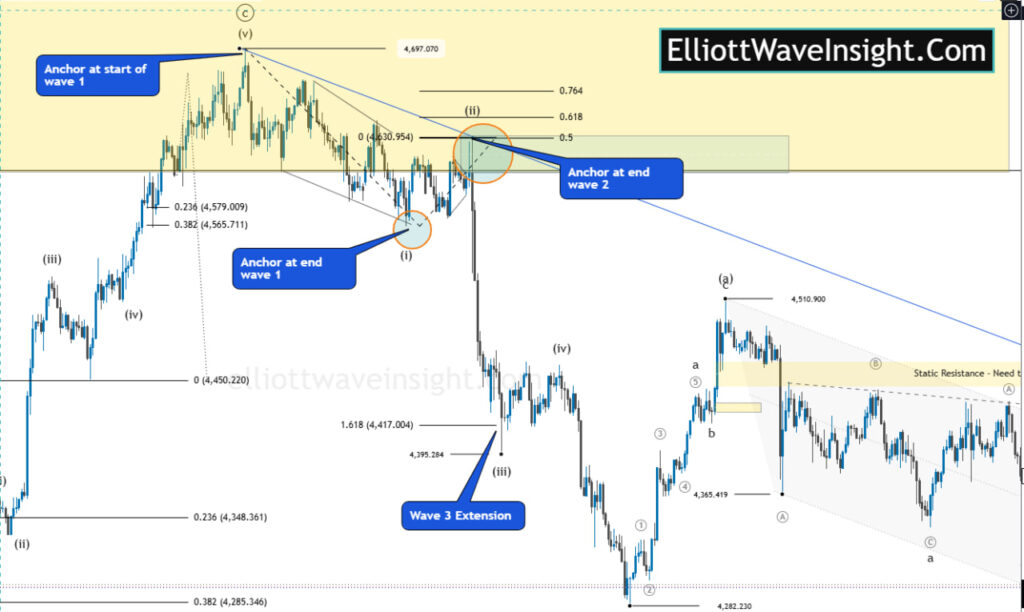
Each anchor pair, start of wave 1 to end of wave 1, then end of wave 1 to end of wave 2, builds a new valid retracement as the wave count develops.
Different traders lean on different extension levels depending on trend strength and risk appetite. A common approach is to scale out at each extension level as price reaches it rather than picking one exit. This locks in profit progressively without forcing you to guess the exact top or bottom of the move.
Risk Management, Invalidation Rules, and Stop Placement
Every Fibonacci-based trade needs a hard rule for when the idea is simply wrong, and that rule should exist before you enter, not after price starts moving against you.
Wikipedia’s entry on Fibonacci retracement frames these levels as zones of interest rather than exact prices, and that framing cuts both ways.
For stop placement, two heuristics cover most situations:
Beyond the next Fibonacci level. If you entered at 61.8%, a stop just past 78.6% or beyond the 100% swing point gives the trade room to breathe without exposing you to unlimited risk.
ATR-based buffer. Using the Average True Range to set a stop distance adapts automatically to how volatile the asset currently is, which matters more in crypto and small-cap stocks than in a slow-moving major forex pair.
Position sizing should tie directly to your risk-to-reward ratio and chosen extension target.
Confluence matters here too. Investopedia’s guide to Fibonacci strategy points out that pairing retracement levels with trendlines, moving averages, or RSI reduces subjectivity and false signals, the two things that quietly erode a trader’s edge over time. Fewer false signals means fewer stopped-out trades, which means your risk management plan actually performs the way you modeled it.
Common Mistakes and the Limits of Fibonacci Retracement
Fibonacci retracement fails most often because of the trader, not the tool. Subjective anchor selection is the biggest culprit: two traders looking at the identical chart can draw meaningfully different levels depending on which swing they pick, and that subjectivity opens the door to confirmation bias, where you unconsciously choose anchors that support a trade you already wanted to take.
The tool also breaks down in choppy, non-trending markets. Fibonacci retracement works best in trending conditions, according to OANDA’s technical analysis education, and sideways price action produces false signals because there’s no clean impulse leg to anchor against in the first place. In a range-bound market, switch to support and resistance zones or a range-trading approach instead of forcing a retracement tool onto a trend that doesn’t exist.
Chart clutter compounds both problems. Traders who draw retracements from every visible swing, then add extensions, pivot points, and five moving averages on top, end up with so many overlapping lines that literally any price level can be justified as significant. Simplification fixes this:
Draw retracements only from the single most obvious, most recent impulse leg.
Limit your confirmation tools to two or three, not six or seven.
If a level isn’t backed by at least one other form of confluence, treat it as noise rather than signal.
Chart Walkthroughs: Fibonacci Retracement in Practice
Example 1: A live EURUSD retracement into the Golden Zone. After the prior advance, price pulls back into the 0.5 to 0.618 retracement zone, tagging 1.18492 before the count resumes. The Golden Zone isn’t just a percentage band here, it lines up with the wave structure itself, which is exactly the kind of confluence this article’s Elliott Wave section covers in more depth.
EURUSD retraces into the 0.5 to 0.618 Golden Zone at 1.18492 before the count resumes, a live example of Fibonacci and wave structure lining up.
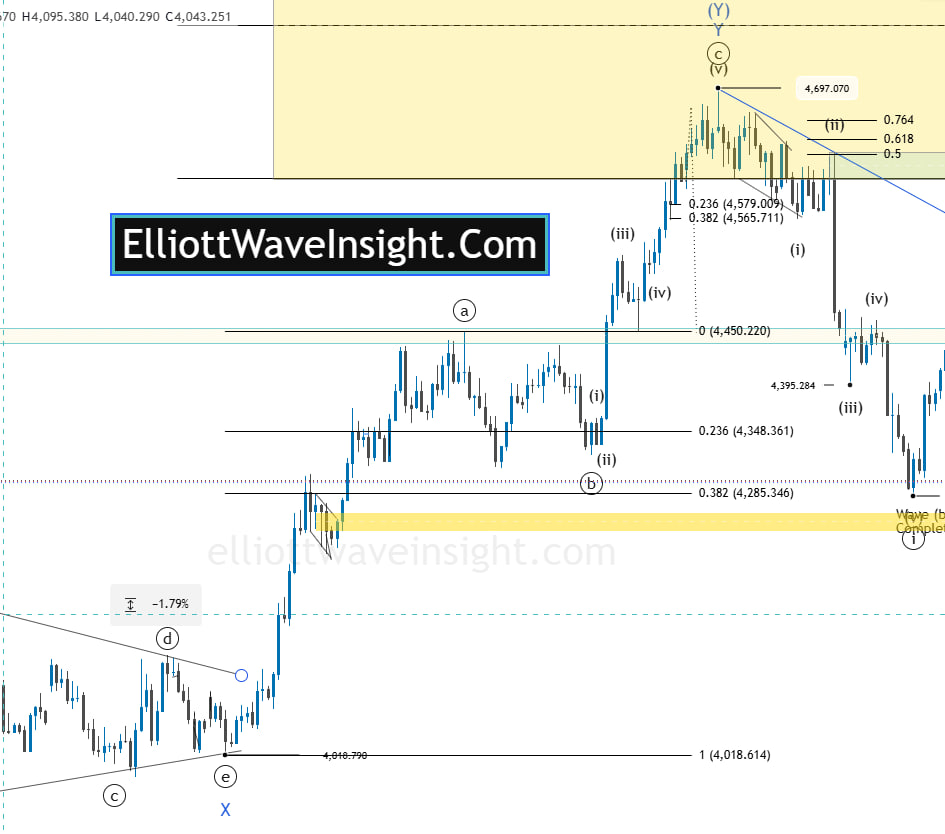
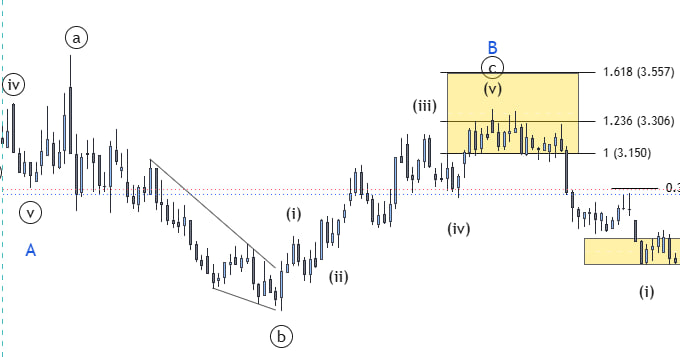
Example 2: A gold shallow retracement in a strong impulse. After wave (i) completes, price pulls back to only the 0.382 level rather than the deeper Golden Zone, a shallow retracement typical of a trend that isn’t done moving. Wave (iii) then extends sharply higher, and wave (iv) produces another shallow pullback near the highs before the move completes.
Gold retraces only to the 0.382 level after wave (i), a shallow pullback typical of a trend with more room to run before wave (iii) extends
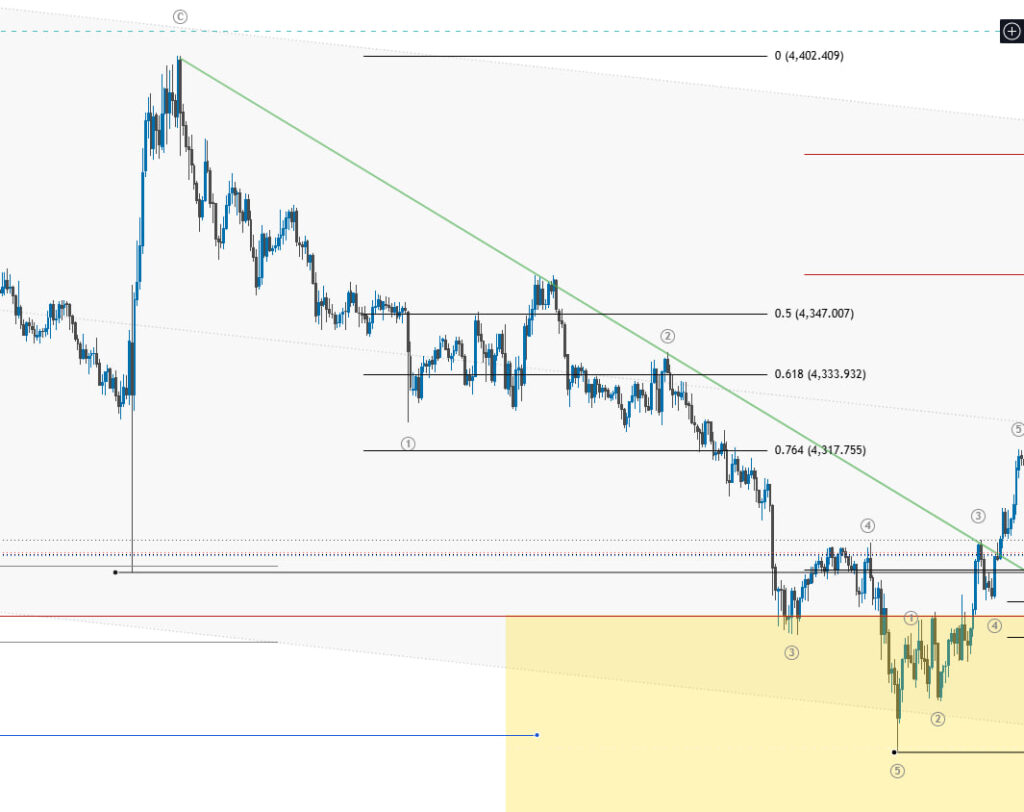
Example 3: A failed reversal at the Golden Zone. Price declines into the 0.5 to 0.618 zone and forms a small basing attempt, but the bounce fails to make a new high, a sign the level didn’t hold with real conviction. Rather than force a long against a reversal that never confirmed, the disciplined read is to stand aside until price actually proves the zone holds.
Price bounces at the Golden Zone but fails to make a new high, a reversal that never confirmed.
Elliott Wave Insight Perspective: Integrating Fibonacci With Wave Structure
Fibonacci retracement gets far more precise once you know which wave you’re actually measuring, and this is the piece most retail guides skip entirely. Elliott Wave analysis identifies the underlying market structure, impulse waves, corrective waves, diagonals, before you ever touch the Fibonacci tool, which solves the anchor selection problem at its root. Instead of guessing which swing qualifies as “the” impulse leg, a wave count tells you explicitly: anchor to Wave 1 through Wave 3, or to Wave A through Wave C, depending on the structure in play.
Wave targets and Fibonacci extensions tend to converge in a way that single-tool traders never see. When your extension target and your wave count target land at the same price, you’ve found genuine confluence, not the coincidental kind that comes from stacking unrelated indicators.
Elliott Wave Insight’s daily research is built around this overlap, tracking wave counts across Forex, stocks, crypto, and gold so traders aren’t drawing Fibonacci levels in a structural vacuum. The resources that support this workflow include:
Daily wave counts across 30+ markets, updated with the impulse and corrective structure already mapped out.
MT5 Expert Advisors that apply structured trade plans with built-in risk management.
The Elliott Wave Academy, a multi-module educational hub covering wave identification and anchor selection in depth.
Worked examples like the EURUSD Wave (E) setup and the Bitcoin Cycle Wave IV triangle roadmap, showing how wave counts and Fibonacci levels interact across timeframes.
An Editorial Take on Fibonacci Discipline
Most traders don’t fail at Fibonacci retracement because the tool doesn’t work. They fail because they treat a probabilistic zone like a guaranteed price and skip the confirmation step that makes the whole approach honest. The traders who do well with this tool are boring about it: same anchor rules every time, same confirmation checklist, same invalidation point, trade after trade.
Before your next setup, run through this:
Anchor to the clearest impulse leg on your chosen timeframe.
Wait for at least one confirmation signal inside the retracement zone.
Check for confluence with a moving average, trendline, or prior support/resistance.
Set your stop beyond the 100% swing point, not inside it.
Plan your extension target before you enter, not after price starts moving.
Drawing a clean Fibonacci retracement is only half the job. Knowing which swing to anchor to, and having that anchor confirmed by an actual wave structure, is what separates a repeatable setup from a guess dressed up in percentages. Elliott Wave Insight builds its daily research around exactly that gap, pairing wave counts across Forex, stocks, crypto, and gold with the Fibonacci confluence points traders already rely on.
Elliott Wave Insight provides daily wave counts across multiple markets, live market intelligence with real-time key levels, integrated MT5 Expert Advisors for automated trade execution, an automated trade journal for tracking equity and performance, and structured, self-paced Elliott Wave education. Instead of manually second-guessing which swing high or swing low deserves your Fibonacci anchor, you get a wave count that’s already done that work, with extension targets that often line up with the very Fibonacci levels this article covers. If you want to see how wave structure and Fibonacci confluence work together on live charts, start with Elliott Wave Insight’s daily analysis and check today’s setups against your own watchlist.
How Do I Use Fibonacci Retracement in Trading? Identify a clear impulse leg, anchor the tool from swing low to swing high (or the reverse in a downtrend), then wait for a confirmation signal, like a candlestick reversal, volume spike, or moving average overlap, inside a retracement zone before entering.
Do Fibonacci Retracements Actually Work? They work in a probabilistic sense in trending markets, meaning price reacts at these levels often enough to be useful, but BabyPips notes they don’t guarantee a reversal, which is why confirmation matters more than the level itself.
Is the 50% Retracement a Fibonacci Level? No. The 50% level isn’t derived from the Fibonacci sequence, but Investing.com explains traders include it anyway because it acts as a widely watched psychological midpoint that price often respects.
Do Professional Traders Use Fibonacci? Yes, though typically as one layer of confluence rather than a standalone signal. Professional and institutional traders commonly pair Fibonacci levels with moving averages, trendlines, or wave structure, an approach services like Elliott Wave Insight build directly into their daily analysis.
What Is the Golden Zone in Fibonacci Trading? The Golden Zone is the price band between the 50% and 61.8% retracement levels, an area case studies from outlets like FXEmpire repeatedly flag as a high-probability re-entry zone when confirmed by price action and volume.
If you are looking for an Elliott Wave course, you have probably already found the problem. There are dozens of them, they all promise the same things, and most of the free material contradicts itself. Half of what circulates online gets the basic rules wrong.
This post covers what separates a good Elliott Wave course from a bad one, the three things most of them skip, and the one I took myself and now recommend.
What you are actually trying to learn
Elliott Wave is not a prediction system. It is a way of describing the shape of price movement.
The core observation is that markets move in recognisable patterns that repeat at every scale. Trending moves subdivide into five waves. Corrections subdivide into three. Those corrections come in a handful of named forms: zigzags, flats, triangles, and combinations of those joined together. A five-wave advance on a one-minute chart has the same structure as one spanning forty years.
That is the whole framework. Everything else is detail about telling one pattern from another and knowing what each implies about what comes next.
The value is not that it gives you targets. It is that it tells you when you are wrong. A valid count comes with rules attached, and when price breaks one of them the count is dead and you know immediately. That is worth more than a price projection.
Three things most Elliott Wave courses skip
Free videos and cheap courses cover impulses well enough. Here is where they run out.
Degree
Every wave sits inside a larger wave and contains smaller ones. Getting the degree wrong is the most common error in the whole framework, and it propagates: label a structure one level too high and everything nested inside it is wrong too.
Most beginners assign degree from the bottom up, which almost guarantees a rebuild when they zoom out. A course worth paying for teaches you to anchor from the largest visible structure and count down, and gives you the typical duration for each degree so you can sanity-check what you have labelled.
The rules are not guidelines
Wave two cannot retrace beyond the start of wave one. Wave three cannot be the shortest of waves one, three and five. Wave four cannot enter wave one’s price territory, unless the structure is a diagonal, in which case it must.
These are hard constraints. A count that breaks one is not a weak count, it is not a count at all. A surprising amount of published wave analysis quietly ignores this, which is why so much of it is unfalsifiable.
Corrections
Impulses are straightforward. Corrections are where most of your chart time goes and where nearly all the mistakes happen.
The difference between a running flat and an expanded flat changes what you expect next. A double three looks like noise until you can see the three separate structures inside it. Triangles appear in specific positions and nowhere else, and knowing which positions is half the value of spotting one.
Any Elliott Wave course that spends most of its time on impulses is teaching you the easy quarter of the subject.
The Elliott Wave course we recommend
I took Mudassar’s Elliott Wave Principle on Udemy myself, and it is the one I point people to.
It runs to roughly 16 hours across 47 lectures, rated 4.6 by more than 7,000 learners. What makes it worth the time is that it covers all three of the gaps above rather than just the first quarter.
On corrections, it works through regular and expanded flats, running flats, contracting and expanding triangles, barrier and running triangles, single, double and triple zigzags, and combinations. Each one gets a real chart example rather than an idealised diagram, which matters because textbook patterns and market patterns look different.
On validity, it covers the rules and labelling conventions, position of patterns, alternation, extension and truncation, channelling and wave equality, and what he calls the right look, which is the judgement about whether a structure is proportioned correctly. That last one is the hardest thing to teach and the thing that separates a count from a guess.
On application, there is a section combining wave counts with RSI, which matters because momentum is one of the few independent checks on whether a fifth wave is genuinely terminal. And there is a live trading sequence taking a NASDAQ position through analysis, entry, trailing stops and exit, which shows the decision-making between having a count and placing a trade.
The course includes downloadable resources and assignments where you label charts yourself. That part is not optional. You do not learn this by watching.
It will not make you profitable. None of them will, and any course claiming otherwise is selling something other than education.
Wave counting will not tell you what size to trade, how to place a stop relative to your account rather than the chart, or how to stop yourself re-entering a losing idea four times in twenty minutes. Those are separate disciplines and they cost people far more money than bad counts do.
What the framework gives you is a structure for thinking about price, a clear definition of when you are wrong, and market context that is more useful than most alternatives. That is a genuine edge. It is not a complete one, and anyone telling you otherwise is not being straight with you.
Where to go next
Learn the framework first. Then read published analysis with the labels making sense to you instead of washing over you.
If you already know the basics and would rather have the counts than do the work yourself, that is what our membership covers. The free tier gives you summaries and charts as they publish, which is a reasonable way to see whether the approach suits how you think before paying for anything.
Disclosure: Elliott Wave Insight is an affiliate partner. We may earn a commission if you purchase through the link above, at no extra cost to you. Trading involves substantial risk of loss and is not suitable for everyone. Nothing in this post is a recommendation to buy or sell any instrument.
At a Glance
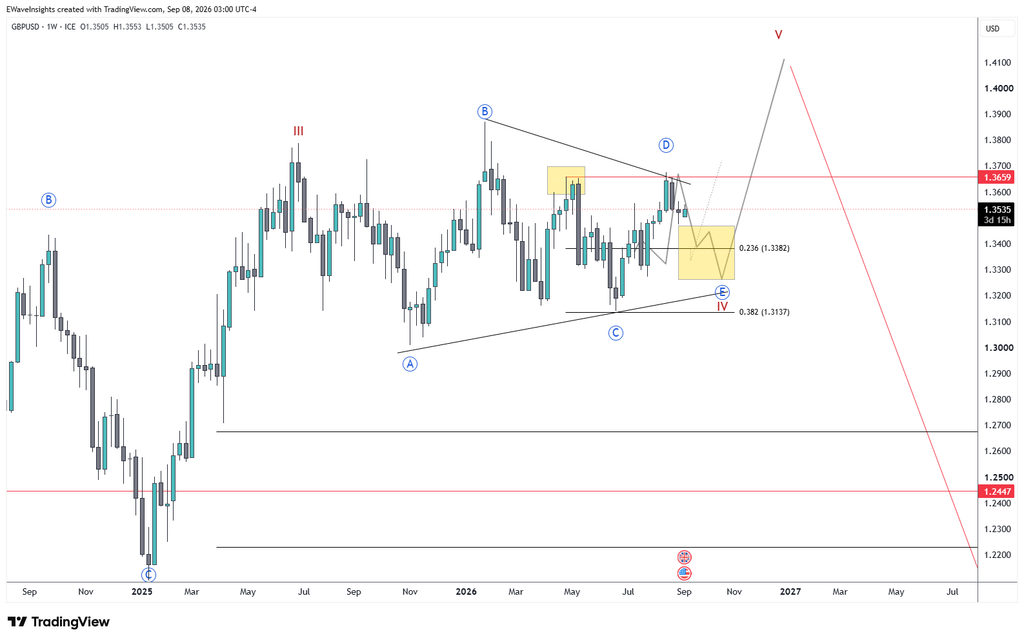
This GBPUSD Elliott Wave analysis tracks the Primary degree triangle on the weekly chart, where wave ((D)) is now complete and price is developing the final leg, wave ((E)), lower before the triangle resolves.
Bias: Bullish (multi-month), pending completion of wave ((E)) Last updated: 8 September 2026
GBPUSD has been building the same Grand Supercycle degree triangle since 1971, and the current leg, Cycle wave IV, has been forming since June 2025. That’s a long enough timeline that a single snapshot goes stale fast, so this page is kept current as the structure develops rather than written once.
Current GBPUSD Elliott Wave Count
Grand Supercycle: ((a))-((b))-((c))-((d))-((e)) triangle from 1971
Supercycle: (a)-(b)-(c) of Grand Supercycle wave ((d)), currently unfolding wave (a)
Cycle: I-II-III-IV-V from 2022, currently in wave IV, part of Supercycle wave (a)
Primary: ((A))-((B))-((C))-((D))-((E)) triangle forming Cycle wave IV, started 30 June 2025, with wave ((D)) now complete
Intermediate/Minor: wave ((E)) developing as a corrective leg lower on the weekly chart
Cycle wave III completed its advance, and the market has spent the time since building out a Primary degree triangle for Cycle wave IV, underway since late June 2025. Triangles unfold in five overlapping legs labelled ((A)) through ((E)), and four of those five legs are now in place. Wave ((E)) is the last piece: a corrective dip that keeps the price action inside the triangle’s boundary lines before the structure resolves. Once Cycle wave IV completes, the next leg higher, Cycle wave V, is expected to complete the larger Supercycle wave (a) within the multi-decade Grand Supercycle triangle, so this triangle is a pause within a much longer-running structure rather than a standalone pattern.
A reliable GBPUSD Elliott Wave count like this one also has to satisfy the standard Fibonacci retracement relationships between its legs, alongside the guideline of alternation, which says wave ((B)) and wave ((D)) in a triangle should look different in shape and depth from each other. Both hold up here: wave ((D)) retraced a smaller portion of wave ((C)) than wave ((B)) did of wave ((A)), which is typical of a contracting triangle and adds confidence to labelling the current dip as wave ((E)) rather than the start of something larger.
Key Levels
Level
Price
Why It Matters
Key Resistance
1.3659
Upper boundary of the triangle. A weekly close above this would suggest wave ((E)) has already bottomed.
Key Support
1.3382
0.236 retracement of the wave ((D)) advance. First area where wave ((E)) could find support.
Invalidation
1.3137
0.382 retracement. A sustained break below here would call the current triangle count into question.
Next Target
Above 1.3900
Projected area for the Cycle wave V advance once wave ((E)) and the triangle complete.
What This GBPUSD Elliott Wave Count Means for Traders
While wave ((E)) is still developing, expect choppy, overlapping price action inside the 1.3137 to 1.3659 range rather than a clean directional move; that overlap is itself a signature of triangle waves. The bigger picture stays bullish: once wave ((E)) completes, the triangle points to a Cycle wave V advance, with the triangle’s width used to project the size of that move. A weekly close back above 1.3659 would be the first sign that wave ((E)) has already found its low.
This is analysis, not personalised financial advice. Trading carries risk of loss and this page should be read alongside your own risk management.
This page reflects the public summary of our GBPUSD Elliott Wave analysis. EWI members get the complete Primary and Intermediate degree breakdown, live price alerts on the key levels above, and daily updates across 30 tracked markets. See Premium →
An ABC correction is the most fundamental corrective structure in Elliott Wave Theory. Whenever a market finishes an impulsive move, whether that’s a small five-wave rally on a 1-hour chart or a multi-year bull run, the market doesn’t simply reverse in a straight line. Instead, it typically retraces in three distinct legs labelled A, B, and C.
Every abc correction pattern falls into one of two main families: the zigzag and the flat correction. Both share the same A-B-C labelling, but their internal structure, Fibonacci targets, and market implications are very different. Understanding which one you’re looking at is essential for anyone using Elliott Wave analysis to time entries, set stop losses, or anticipate where a pullback is likely to end.
In this guide, we’ll break down what an abc correction is, how to tell a zigzag apart from a flat correction, the rules that govern a valid abc correction pattern, how Fibonacci levels help forecast where it will end, and what typically happens in an abc correction after wave 5.
What Is an ABC Correction?
An abc correction is a three-wave corrective structure that moves against the direction of the preceding trend. Ralph Nelson Elliott identified this pattern as the market’s natural way of correcting an impulsive move before the next trending phase begins.
The three legs are:
Wave A — the initial move against the prior trend.
Wave B — a partial or deep retracement of wave A, moving back in the direction of the original trend.
Wave C — the final leg, which completes the correction and is typically followed by trend resumption.
The internal structure of waves A, B, and C is what determines which type of abc correction wave you’re dealing with, and this is where the zigzag and the flat correction diverge sharply.
Zigzag vs Flat Correction: The Two Core ABC Patterns
Feature
Zigzag
Flat Correction
Wave A structure
5-wave impulse
3-wave corrective
Wave B retrace
50–79.6% of Wave A
90–125%+ of Wave A
Wave C structure
5-wave impulse
5-wave impulse
Overall shape
Sharp, angled “Z” shape
Sideways, range-bound
Typical position
Wave 2, 4, or B
Wave 2, 4, B, or X
Market signal
Corrective pullback against trend
Strong underlying trend continuing
A standard zigzag: Wave A and Wave C move in five sub-waves, while Wave B retraces 50–79.6% of Wave A.
For the full breakdown of rules, Fibonacci ratios, trade setups, and real chart examples, see our dedicated guides:
Every abc correction pattern, whether zigzag or flat, must satisfy a set of structural rules before it can be labelled with confidence. These abc correction rules are what separate a valid Elliott Wave count from wishful labelling.
Check Wave A’s internal structure first. Five sub-waves points to a zigzag. Three sub-waves points to a flat.
Measure Wave B’s retracement of Wave A. A shallow 50–79.6% retrace confirms a zigzag. A deep 90% or greater retrace confirms a flat, and beyond 105% signals an expanded flat.
Wave C must move in the same direction as Wave A, extending the overall correction rather than reversing it, and should itself be a five-wave impulse in both pattern types.
An abc correction after wave 5 must fully retrace within the price territory of the prior impulse and cannot be confused with the start of a new impulsive trend in the opposite direction until wave C is complete and confirmed.
Don’t force a label. If Wave B retraces more than 79.6% but Wave A only shows three waves, you are looking at a flat, not an aggressive zigzag. If Wave A shows five waves but Wave B retraces less than 50%, reassess before assuming a standard zigzag.
ABC Correction Fibonacci Levels
Fibonacci retracement and extension levels are the standard tool for projecting where an abc correction is likely to end, but the abc correction fib levels you should use depend entirely on which pattern type you’ve identified.
Zigzag Fibonacci Targets
Wave B commonly retraces 50–79.6% of Wave A, with 61.8% the most frequent.
Wave C often equals the length of Wave A (a 1.0 extension), or extends to 123.6–161.8% of Wave A.
An expanded flat: Wave B extends beyond the start of Wave A before Wave C completes the correction.
Full detail, including frequency statistics for each ratio and a live XAUUSD example, is covered in our zigzag correction guide.
Flat Correction Fibonacci Targets
Wave B retraces 90–100% of Wave A in a regular flat, 105–125% in an expanded flat, and beyond 125% in a rare running flat.
Wave C typically reaches the 1.236–1.618 extension of Wave A, with 1.618 the most common primary target.
Full detail, including all three flat sub-types and a live XAUUSD example, is covered in our flat correction guide.
ABC Correction After Wave 5
One of the most practical applications of this pattern is identifying an abc correction after wave 5. Once a five-wave impulse completes, whether that’s wave 5 of a smaller degree or the final wave of a larger Elliott Wave cycle, the market almost always needs to correct that advance before the next impulsive phase begins.
This is where distinguishing between a zigzag and a flat becomes critical for trade planning:
If the correction after wave 5 forms as a zigzag, expect a sharp, fast retracement of 50–79.6% before the next impulsive move begins, often signalling the trend is still intact but taking a decisive breather.
If it forms as a flat, particularly an expanded flat, expect a slower, sideways retracement that retraces deep into Wave A territory before Wave C completes. This pattern is often a sign of a very strong underlying trend that will resume with force once the flat completes.
Confirming that wave C has completed, ideally with momentum divergence or a clear five-wave sub-structure, gives traders a higher-confidence entry point in the direction of the original trend.
Common Mistakes When Labelling an ABC Correction
Confusing wave B for the start of a new trend. Because wave B moves in the same direction as the original impulse, it’s tempting to assume the trend has resumed. Always wait for wave C to develop before drawing that conclusion.
Forcing a zigzag label onto what is actually a flat. If wave A only shows three sub-waves rather than five, the structure is a flat, not a zigzag, and the Fibonacci targets change accordingly.
Using only the 100% Wave A target for Wave C in a flat. Flat corrections most commonly see Wave C reach 1.618 times Wave A, not just an equal move.
Ignoring the running flat and truncated zigzag possibilities. Both are less common but signal an unusually strong underlying trend once identified correctly.
Final Thoughts
The abc correction is the building block behind nearly every corrective structure in Elliott Wave Theory, from simple pullbacks to complex double and triple three combinations. Learning to distinguish a zigzag from a flat, applying the correct Fibonacci levels for each, and correctly identifying an abc correction after wave 5 will sharpen your wave counts and improve your timing on both entries and exits.
For the complete rules, Fibonacci tables, identification checklists, and live chart examples, explore our full guides on the zigzag correction and the flat correction, or follow our daily Elliott Wave analysis for updated charts and wave counts as these patterns form in real time across gold, indices, and forex pairs.
Tired of juggling multiple exchange logins to track your crypto trades? CoinTracker syncs with 300+ wallets and exchanges, automatically importing your Elliott Wave trades from TradingView sessions.
Key Benefits for Traders:
Real-time P&L on your impulse/correction setups
Tax-ready reports (FIFO, LIFO, HIFO) for UK filings
Historical performance charts to validate wave counts
Mobile alerts when positions hit key Fib levels
Perfect companion for Elliott Wave Insights members – track every ((1))-((5)) cycle with zero manual entry. Connect once, trade forever.
Master the Most Common Corrective Pattern · Rules, Guidelines & Trading Applications
What is a Zigzag?
A zigzag is one of the most common Elliott Wave corrective patterns. It consists of three waves (A-B-C) that move sharply against the larger trend, creating a distinctive “Z” shape on the chart. Zigzags are highly directional reversals with clear structure and reliable Fibonacci targets, making them essential for traders to identify and trade.
Zigzag Structure: A-B-C Breakdown
Wave
Structure
Direction
Characteristic
Wave A
5-wave impulse (or 3-wave)
Against trend
Sharp, decisive move down (or up)
Wave B
3-wave correction (any type)
Against Wave A (bounce)
Retraces 50%–79.6% of Wave A
Wave C
5-wave impulse
Same as Wave A
Sharp move, often extends 1.236–1.618 of Wave A
Key Point: Zigzags are characterized by sharp, impulse-like moves in waves A and C, with a corrective bounce in Wave B.
Official Zigzag Rules
Rule 1: Wave A Structure
✅ Wave A MUST be a 5-wave impulse (or 3-wave in rare cases) ✅ ALWAYS moves OPPOSITE to the preceding trend ✅ Cannot overlap Wave 4 of the preceding impulse
Rule 2: Wave B Retracement
✅ MUST be a 3-wave corrective structure ✅ Retraces 50–79.6% of Wave A ❌ CANNOT retrace more than 100% of Wave A
Rule 3: Wave C Structure
✅ MUST be a 5-wave impulse ✅ Typically reaches 61.8–100% of Wave A ✅ Can extend to 123.6% or 161.8% of Wave A
Rule 4: Zigzag as a Whole
✅ 7-swing structure (5+3+5) ✅ Retraces 50–79.6% of the preceding impulse ✅ Occurs in positions 2, 4, A, or B of larger structures
Fibonacci Relationships in Zigzags
Wave B Retracement of Wave A
Fib Level
Typical Range
Frequency
Notes
50%
Shallow retrace
20%
Less common, indicates strength
61.8%
MOST COMMON
60%
Golden ratio – target this first
76.4%
Deeper retrace
15%
Still valid zigzag
79.6%
Maximum valid
5%
At limit – deeper = not a zigzag
Wave C Extent Compared to Wave A
Fib Ratio
Wave C Size
Frequency
Trading Implication
0.618 of A
Shorter C
15%
Weak zigzag – trend resuming
1.0 of A
EQUAL WAVES
50%
Most balanced – primary target
1.236 of A
Extended C
25%
Aggressive downside – deep correction
1.618 of A
Extreme C
10%
Panic selling/buying – violent moves
Types of Zigzags
1. Standard (Most Common)
Structure: A (5) → B (61.8%) → C (100% of A) Frequency: 50% Trading: Most reliable, easy to trade
2. Extended (Aggressive)
Structure: A (5) → B (shallow) → C (1.236–1.618 of A) Frequency: 25% Trading: More profit, higher risk
3. Truncated (Weak)
Structure: A (5) → B (3) → C (0.618 of A only) Frequency: 15% Trading: Weak – trend resuming quickly
4. Double/Triple (Complex)
Structure: W → X → Y [→ X → Z] Frequency: 10% Trading: Multiple entry points, takes longer
Trading Zigzag Patterns
Setup 1: Anticipate Wave C From Wave B High
After Wave B completes, set sell orders at 100% or 123.6% of Wave A extension from Wave B start.
Wave B retrace
61.8% of A
Entry
At Wave B high, anticipating C wave down
Target C
100% or 123.6% of Wave A extent
Risk
Above Wave B high (invalidation)
Setup 2: Trade the Wave C Breakout
After Wave C completes, trade the trend resumption above Wave A high.
Confirmation
Close above Wave A high = zigzag complete
Entry
BUY break above Wave A high + pullback
Target
Wave 1 of new impulse
Stop
Below Wave C low
Setup 3: Wave B Bounce Trade
Trade the bounce from Wave A low up to the 61.8% retracement.
Entry
At Wave A low (start of Wave B)
Target
61.8% of Wave A (Wave B expected high)
Stop
Below Wave A low
Duration
Quick 1–3 day trade
Zigzag Identification Checklist
Does Wave A have 5-wave subdivision?
Is Wave A moving AGAINST the larger trend?
Does Wave B retrace 50–79.6% of Wave A? (61.8% most common)
Is Wave B a 3-wave structure (ABC)?
Does Wave C have 5-wave impulse structure?
Is Wave C moving in the same direction as Wave A?
Does Wave C reach 61.8–161.8% of Wave A (typically 100%)?
Does the whole zigzag retrace 50–79.6% of the prior impulse?
After completion, does price break above Wave A high?
No overlap violations between waves
Common Zigzag Mistakes to Avoid
❌ Mistake 1: Calling a Wave B retrace >79.6% a zigzag. ✓ Fix: If B retraces >79.6%, it’s likely a flat or other corrective structure.
❌ Mistake 2: Forcing a 3-wave pattern into a zigzag. ✓ Fix: Wave A MUST have 5 waves. 3-wave A = NOT a zigzag.
❌ Mistake 3: Entering Wave C before Wave B is confirmed. ✓ Fix: Wait for Wave B to hit the Fib level before shorting.
❌ Mistake 4: Using Wave A as the only Wave C target. ✓ Fix: Wave C often extends to 1.236–1.618× Wave A.
❌ Mistake 5: Dismissing a pattern because Wave B looks “too big.” ✓ Fix: Wave B can retrace 50–79.6% – trust the math, not the eye.
Real Example: XAUUSD Zigzag
Gold completes Wave 5 of impulse at 4,800, then enters Wave 2 correction.
Wave
Structure
Price Level
Fib Notes
Wave A Down
5-wave impulse
4,800 → 4,500 (300 pips)
Sharp down
Wave B Up
3-wave bounce
4,500 → 4,685 (185 pips)
61.8% of 300p = 185p ✓
Wave C Down
5-wave impulse
4,685 → 4,415 (270 pips)
90% of Wave A ✓
Trade Plan
1. SHORT at 4,685 (Wave B high) 2. Target: 4,415 (100% of Wave A from 4,685) 3. Stop: 4,750 (above Wave B high) 4. R/R: 270 pips / 65 pips = 4:1 ✓
W-X-Y Correction Structure
Wave Component
Wave Structure
Trading Implication
Wave W
5-wave corrective pattern (down)
Initial correction – establishes support
Wave X
3-wave countertrend (up)
Connecting bounce – more correction ahead
Wave Y
5-wave or complex (down)
Final target – deeper than Wave W alone
⚠️ Why W-X-Y Matters: Traders expecting a simple A-B-C zigzag get stopped out when Wave X completes and Wave Y begins. Use 0.618–0.764 Fib extension levels to anticipate Wave Y completion.
Quick Reference: Zigzag Essentials
Structure: A (5 waves) → B (3 waves, 61.8% retrace) → C (5 waves, 100% of A)
Best Fib Levels: Wave B = 61.8% of A | Wave C = 100–123.6% of A
Master sideways Elliott Wave flat corrections with Wave A, B, C structure. Learn Fibonacci extensions (1.272–1.618), wave B retracement rules (90–110%), and three flat correction types for professional trading analysis.
THE FOUNDATION OF ACCURATE CHART ANALYSIS
INTRODUCTION
Most traders label waves incorrectly. They’ll identify a 5-wave structure on their daily chart and call it “Wave 3.” Then they move to the hourly chart and apply the same labels, creating confusion and lost trades.
The truth? Elliott Waves don’t exist in isolation. They nest within each other across multiple timeframes. Understanding Elliott Wave Degrees is what separates professionals from amateurs who guess their way through charts.
This isn’t a advanced concept. It’s foundational. And once you master it, every single Elliott Wave pattern becomes easier to identify.
Reference chart for all nine Elliott Wave degrees including their standardized notation: from Grand Supercycle to Subminuette. Shows recommended symbols for both motive and corrective waves at every degree.
WHAT ARE WAVE DEGREES?
Definition: Wave degrees are the hierarchical levels at which Elliott Wave structures occur. Every wave degree follows the same 5-3 structure—just at different timeframes.
Think of it like Russian nesting dolls. Your daily chart’s Wave 3 contains multiple hourly waves. Each hourly wave contains multiple minute waves. And each minute wave contains multiple minuette waves.
The pattern repeats infinitely.
This is the fractal nature of Elliott Waves, and it’s why you see the same structures repeating on every timeframe.
THE 9 WAVE DEGREES (LARGEST TO SMALLEST)
Degree
Timeframe
Duration
Grand Supercycle
Generational
40-80+ years
Supercycle
Multi-year
7-15 years
Cycle
Yearly
2-3 years
Primary
Multi-month
3-12 months
Intermediate
Weekly/Monthly
1-3 months
Minor
Weekly/Daily
1-4 weeks
Minute
Daily/Hourly
6-24 hours
Minuette
Hourly/Minutes
15 mins – 2 hours
Sub-Minuette
Minutes/Seconds
Seconds – 15 minutes
Key Point: Each degree uses the SAME labelling (1-2-3-4-5 for motive, A-B-C for corrective). The only difference is the timeframe.
WHY THIS MATTERS FOR TRADING
Multi-Timeframe Confirmation:
Your daily chart shows a 5-wave Minor impulse
Your hourly chart shows that same 5-wave pattern breaking into 5 Minute waves each
Your 15-minute chart shows those patterns breaking into 5 Minuette waves each
When all three timeframes align in wave degree, your setup probability increases dramatically.
Example: If you’re trading a daily Minor Wave 3:
Entry: When Minute Wave 1 completes on the hourly chart
Pyramid: As Minute Waves escalate during Minor Wave 3
Exit: When Minute Wave 5 completes (signaling Minor Wave 3 completion is near)
This is how professionals trade with precision. They’re not guessing—they’re reading nested structures.
CORRECT LABELLING RULES
Multi-timeframe wave degree analysis in action: USD/JPY weekly chart spanning 2021-2026 showing nested degrees from Cycle (largest, top labels) down through Primary, Intermediate, and Minor (smallest visible). Roman numerals mark the Cycle degree structure (I, II, III, V), while letters and numbers label smaller degrees within each move. This demonstrates why traders must label consistently across all timeframe hierarchies.
Rule 1: Motive Waves = Always 1-2-3-4-5
Never label them as repeating: 1-2-1-2-1. The numbers represent progression through the structure, not cyclical repetition.
These must follow the corrective pattern. If it doesn’t fit, it hasn’t completed yet.
✓ Correct: Wave A → Wave B → Wave C (zigzag, flat, or triangle) ✗ Incorrect: Wave A → Wave B (waiting for Wave C before labelling complete)
Why Rule 2 Emphasizes A-B-C: Rule 2 highlights that the fundamental building block of corrective structures is the A-B-C pattern. Even complex corrections are made up of multiple A-B-C sections. Therefore, when labelling charts, one must ensure each section is a complete A-B-C before moving on to the next.
Incomplete Labels: Labeling a correction as just Waves A and B is premature until Wave C fully develops to complete that segment. This caution helps prevent misidentifying ongoing corrective movements that remain unfinished.
This rule does not deny the existence of complex corrections but enforces clarity and completeness when identifying parts of them.
Rule 3: Degree Consistency Within Timeframe
Choose ONE timeframe and stick with one degree level for that chart.
✓ Correct:
Daily chart = Minor/Intermediate degree
Hourly chart = Minute degree
15-min chart = Minuette degree
✗ Incorrect:
Mixing degrees (calling some Minute, others Minor on the same daily chart)
Jumping degrees inconsistently
Why Mixing or Jumping Degrees Is Wrong
Mixing degrees (for example, labeling some waves as “Minute” and others as “Minor” on the same timeframe) leads to confusion and inconsistencies. Each degree (like Primary, Intermediate, Minor, Minute, etc.) should be used in a strict, logical sequence. On any given chart, if you label one wave “Minor,” all other waves of that rank must also use “Minor”—don’t jump around or swap terms between swings.
Jumping degrees inconsistently means skipping logical wave degrees or flipping between ranks. For example, labeling a move as “Minute” and then its next subdivision as “Primary” is inconsistent (Minute is a smaller scale than Primary). You must always step up or down the degree sequence properly: Primary → Intermediate → Minor → Minute → Minuette, etc.
Rule 4: Larger Degree = Larger Structure
A Cycle degree wave is MUCH larger than a Minor degree wave. You can’t label a 2-day move as “Cycle” degree when your context is multi-year trends.
COMMON LABELLING MISTAKES (AND HOW TO FIX THEM)
Mistake #1: Forcing Structure Before Completion ❌ You see 3 waves and immediately call them A-B-C before Wave C finishes ✅ Wait for completion signals (Wave C closes below Wave A, or completes the pattern structure)
Mistake #2: Mislabeling Wave 4/Wave 2 ❌ You see a pullback and call it Wave 4, even though it violates Wave 4 rules ✅ Verify Wave 4 does NOT overlap into Wave 1 price territory before labeling
Mistake #3: Inconsistent Degrees Across Charts ❌ You call daily waves “Minor” but hourly waves “Intermediate” ✅ Maintain consistent hierarchy (if daily is Minor, hourly is Minute)
Mistake #4: Confusing Retracements with Completions ❌ A 38% retracement looks “complete” but it’s just a shallow correction ✅ Wait for full structure completion, not just retracement targets
MULTI-TIMEFRAME LABELLING WORKFLOW
Step 1: Choose Your Primary Timeframe (e.g., Daily chart)
Step 3: Label Current Structure (1-2-3-4-5 or A-B-C based on direction)
Step 4: Drop Down to Next Smaller Timeframe (Hourly chart to label Minute degree)
Step 5: Use Smaller Degree for Entry/Exit Precision (Trade Minute waves WITHIN Minor wave movements)
Step 6: Return to Primary Timeframe for Confirmation (Verify larger degree structure supports smaller degree moves)
KEY TAKEAWAYS
✓ Wave degrees explain the fractal structure of all markets ✓ 9 degrees from Grand Supercycle down to Sub-Minuette ✓ Same labelling (1-2-3-4-5 / A-B-C) applies to ALL degrees ✓ Multi-timeframe alignment = higher probability setups ✓ Consistent degree naming prevents confusion ✓ Smaller degrees provide entry/exit precision ✓ Larger degrees provide trend confirmation
You’ve probably seen traders talking about “wave counts” and “Elliott Wave patterns.” But here’s the harsh truth: 95% of traders get wave counting completely wrong and it all starts with not understanding one fundamental concept.
That concept is this: Elliott Wave has TWO modes, not one. And if you don’t know the difference between them, your entire wave count falls apart.
In this guide, I’m going to show you exactly what these two modes are, how to spot them instantly, and most importantly how this one distinction changes your entire trading approach. By the end, you’ll understand why most traders fail at Elliott Wave while the successful ones nail their trades consistently.
Let’s break it down.
WHAT ARE MOTIVE WAVES? (The Trending Mode)
Real Gold (XAU/USD) daily chart showing motive waves (1-2-3-4-5 structure) followed by corrective waves (A-B-C). Notice how Wave 3 is the largest move—this is where traders make the most money.
Motive waves are the powerhouses of price movement. They’re the moves that create profits for disciplined traders.
Here’s the definition: A motive wave is a 5-wave structure that moves in the direction of the primary trend.
Think about it this way: if you’re in an uptrend, a motive wave moves UP. If you’re in a downtrend, a motive wave moves DOWN. The key is that it always moves with the trend, not against it.
The structure looks like this:
Wave 1: The market initiates the move up (or down)
Wave 2: A pullback/correction (but doesn’t erase Wave 1)
Wave 3: The power move the biggest impulse (this is where traders make money)
Wave 4: Another pullback (but doesn’t erase Wave 3)
Wave 5: The final push to complete the trend
Real Example: Imagine Gold is at $4,000. A motive wave might look like:
Wave 1: $4,000 → $4,100 (initial move up)
Wave 2: $4,100 → $4,050 (pullback)
Wave 3: $4,050 → $4,250 (BIG move up this is where you make money)
Wave 4: $4,250 → $4,200 (another pullback)
Wave 5: $4,200 → $4,300 (final push to complete)
The Psychology: Motive waves represent greed and momentum. Early traders jump in (Wave 1), weak hands sell (Wave 2), serious money enters (Wave 3), profit-takers exit (Wave 4), and the last buyers rush in (Wave 5). That’s the natural progression of a trending market.
Why This Matters: When you’re IN a motive wave, you should be aggressive. Full position size. This is your opportunity to make real money. Most traders miss the entire Wave 3 because they don’t recognize they’re in a motive wave structure.
WHAT ARE CORRECTIVE WAVES? (The Consolidation Mode)
Corrective waves are the consolidation periods between trends. They’re where the market catches its breath—and where unprepared traders get trapped.
Here’s the definition: A corrective wave is a 3-wave structure that moves AGAINST the primary trend.
The same Gold chart showing corrective wave patterns (A-B-C). These consolidation moves happen after strong motive waves. Understanding them prevents traders from getting trapped.
If you’re in an uptrend, a corrective wave moves DOWN. If you’re in a downtrend, a corrective wave moves UP. The key difference is that it always moves against the trend (temporarily).
The structure looks like this:
Wave A: The initial move against the trend
Wave B: A bounce back into the previous trend
Wave C: The final push in the corrective direction
Real Example: After that Gold motive wave completed at $4,300, the market needs to correct. A corrective wave might look like:
Wave A: $4,300 → $4,150 (down move against the uptrend)
Wave B: $4,150 → $4,225 (bounce back up)
Wave C: $4,225 → $4,100 (final down move to complete correction)
The Psychology: Corrective waves represent fear and consolidation. Some traders take profits (Wave A down), bargain hunters buy the dip (Wave B up), and then profit-takers return (Wave C down). It’s a temporary disagreement about direction, not a reversal of the trend.
Why This Matters: When you’re IN a corrective wave, you should be defensive. Smaller position size. Tighter stops. This is consolidation territory not where the big money is made. Most traders hold too long during corrections and give back their gains.
THE KEY DIFFERENCE: DIRECTION & PURPOSE
This is where everything clicks into place. Let me lay out the clearest comparison:
Aspect
Motive Wave
Corrective Wave
Structure
5 waves
3 waves
Direction
WITH the trend
AGAINST the trend
Purpose
Create new price levels
Consolidate/retrace
Psychology
Greed, momentum, conviction
Fear, profit-taking, uncertainty
Time Duration
Typically longer
Typically shorter
Magnitude
Larger moves
Smaller moves
How to Trade
AGGRESSIVE (full size)
DEFENSIVE (smaller size)
Where Money is Made
Wave 3 (motive)
Early wave C (corrective)
The Critical Insight: These two modes are the entire foundation of Elliott Wave analysis. If you can identify which mode you’re in, everything else becomes clear. Your entries, exits, position sizing, risk management—it all flows from understanding whether you’re in a motive or corrective wave.
HOW TO IDENTIFY EACH (Visual Clues)
Okay, so knowing the theory is one thing. But how do you actually spot these on your charts in real-time? Here are the practical ways to identify each mode:
IDENTIFYING MOTIVE WAVES:
1. The 5-Wave Count
Most obvious: count 5 distinct waves going in one direction
If you see 5 clear waves with identifiable turning points, you’re likely in a motive wave
2. The Wave 3 Power Move
Wave 3 should be stronger than Wave 1
It’s the most “powerful” looking wave on the chart
Often extends beyond where you’d expect based on Wave 1
Volume typically increases significantly during Wave 3
3. Clear Pullbacks with Structure
Waves 2 and 4 are recognizable pullbacks
They don’t erase the previous wave
Wave 2 never fully erases Wave 1 (this is a RULE)
Wave 4 never fully erases Wave 3 (this is a RULE)
4. Time Duration
Motive waves take longer to develop
They have multiple sub-waves
On a 1-hour chart, could take 3-6 hours
On a daily chart, could take 5-10 days
5. Angle/Aggressiveness
Motive waves move with conviction
The angle is steep and directional
Not choppy or sideways
Clear trend is obvious
IDENTIFYING CORRECTIVE WAVES:
1. The 3-Wave Count
Most obvious: you can identify A-B-C moves
Only 3 main turning points
Simpler structure than motive waves
2. Movement Against Trend
The move opposes the previous motive wave
If previous was up, this is down
If previous was down, this is up
Clear reversal is obvious at the start
3. Variable Angles
Wave A might be steep, Wave B shallow, Wave C steep
Or all three similar angles
Depends on the corrective pattern (zigzag, flat, triangle)
Less consistent than motive waves
4. Time Duration
Corrective waves are typically quicker
On a 1-hour chart, could be 1-2 hours
On a daily chart, could be 2-5 days
Generally faster than motive waves
5. Choppy Price Action
More back-and-forth movement
Less directional
Lots of small wicks and indecision
Feels “sideways” compared to motive waves
THE TRADING DIFFERENCE: AGGRESSIVE vs DEFENSIVE
Here’s where this knowledge becomes money in your pocket (or saves you from losses):
TRADING MOTIVE WAVES (AGGRESSIVE):
When you identify a motive wave, you’re in the “money zone.” This is where you want to be most aggressive.
Setup:
Enter after Wave 2 completes
You’ve confirmed the uptrend and the pullback held support
Place your stop just below Wave 2 low
Target is Wave 3 extension (usually 1.618 × Wave 1 = your first target)
Hold for Wave 3, exit partial profits near Wave 4 start
Position Sizing: 100% (go full size, this is your opportunity)
Target: 1.2800 (Wave C completion = 100% of Wave A – 370 pips from entry)
Risk: 20 pips
Reward: 370 pips
Risk/Reward Ratio: 1:4.18 ✓ (Good for consolidation trade)
GBP/USD corrective wave setup with entry at Wave B failure, tight stops, and 1:4.18 risk/reward ratio.
The Key Difference: You make your serious money in motive waves (especially Wave 3). Corrective waves are where you consolidate profits and wait for the next motive wave setup. A trader who understands this avoids holding corrective positions too long and conserves capital for the big moves.
COMMON MISTAKES TRADERS MAKE
Mistake #1: Confusing the Two Modes
Trader sees a 3-wave move and thinks it’s a motive wave
Places a full-size trade expecting Wave 3 extension
But it’s actually a corrective wave, not a motive wave
Trade fails because the corrective pattern completes
Mistake #2: Trading Too Aggressively in Corrective Waves
Trader enters a corrective wave with full position size
Confuses consolidation for a new trend
Gets trapped when the correction completes
Should have been defensive, not aggressive
Mistake #3: Not Identifying Which Mode You’re In
Trader is analysing wave counts but doesn’t know if it’s motive or corrective
This leads to poor position sizing decisions
Risk management suffers because they don’t know which waves to be aggressive in
Mistake #4: Ignoring the 5 vs 3 Wave Count
Easiest way to tell: Count the waves!
Motive = 5 waves
Corrective = 3 waves
If you count more than 5 waves, you might be zooming out too far or miscounting
WHY THIS FOUNDATION MATTERS
Before you move to more complex Elliott Wave concepts, you need this foundation locked in:
Identifying motive waves tells you when to be aggressive
Identifying corrective waves tells you when to be defensive
Understanding the structure helps you place stops and targets correctly
Knowing the psychology helps you understand why traders act the way they do
Every advanced Elliott Wave concept (extensions, truncations, diagonals, complex corrections) builds on this foundation. If you’re shaky on motive vs corrective, those advanced concepts will confuse you.
So spend time on this. Study motive vs corrective on your favourite trading pair. Stare at Gold charts and identify these two modes. Get comfortable spotting them automatically.
CONCLUSION & ACTION ITEMS
Here’s what you’ve learned: ✅ Motive waves = 5-wave trending structures (WITH the trend) ✅ Corrective waves = 3-wave consolidation structures (AGAINST the trend) ✅ The key difference = Direction, purpose, and how aggressively you trade them ✅ How to identify = Wave count, angle, time duration, and price action characteristics ✅ How to trade differently = Motive (aggressive/full size) vs Corrective (defensive/smaller size)
Your Action Items This Week:
Pull up a chart (Gold, EUR/USD, or S&P 500)
Identify the last 3 complete motive waves
Identify the last 2 complete corrective waves
Write down the structure of each (draw it out if needed)
Practice on multiple timeframes
Next week, we’re diving into Impulse Waves and where the real money is made (Wave 3 extensions). But first, master this foundation.
Ready to take your Elliott Wave analysis to the next level? Join Elliott Wave Insights where we break down chart analysis daily, identify setups in real-time, and help you turn Elliott Wave theory into consistent profits.
Elliott Wave Theory is a technical analysis framework that describes how financial markets move in repetitive, predictable wave patterns. Developed by Ralph Nelson Elliott in the 1930s, this theory reveals that price movements are not random they follow a psychological rhythm created by the collective behaviour of market participants.
At its core, Elliott Wave Theory states that all market movements consist of five impulsive waves moving in the primary trend direction, followed by three corrective waves moving against the trend. This 5-3 pattern repeats across all timeframes, from minute-by-minute intraday charts to multi-year macro trends.
Why Elliott Wave Works
Elliott Wave works because it captures the fundamental truth of market behavior: markets are driven by human emotion. Fear and greed create predictable patterns of buying and selling pressure that repeat with mathematical consistency.
The theory succeeds where other methods fail because it:
Identifies High-Probability Setup Zones — By recognizing wave patterns, traders can pinpoint where price has exhausted its move and is likely to reverse. This transforms market analysis from guesswork into precision targeting.
Provides Risk Management Clarity — Once you identify a wave pattern, you know exactly where your thesis breaks. If price moves past your predetermined wave count invalidation point, the setup is dead. This creates clean entry/exit logic and definable risk.
Works Across All Timeframes — A 5-wave pattern on a 5-minute chart follows the same rules as a 5-wave pattern on a monthly chart. This fractal nature means you can trade intraday scalps or position trade using identical principles.
Captures Momentum Before It Accelerates — By identifying early waves (waves 1, 3, and 5), traders enter moves before the broader market recognizes them, capturing the highest probability, best risk-to-reward setups.
The Psychology Behind Market Waves
Markets move in waves because they reflect investor psychology playing out over time. Each wave represents a distinct phase of crowd behavior:
Wave 1 (Accumulation) — Smart money recognizes opportunity and begins accumulating. The crowd is still pessimistic; volume is modest. This is the “foundation” phase where professionals quietly position.
Wave 2 (Profit-Taking) — Early buyers take profits. New shorts enter confidently, convinced the old trend is resuming. This is the “shake-out” that removes weak hands and creates consolidation.
Wave 3 (Euphoria) — The crowd finally recognizes the new trend. FOMO (fear of missing out) drives explosive buying. Volume surges, indicators reach extremes. This is the strongest, most reliable wave-professionals ride this wave hard.
Wave 4 (Consolidation) — Profit-taking again. Traders with early positions lock in gains. A complex sideways pattern forms. The crowd gets nervous thinking the trend is ending, but smart money knows it’s just a setup for the final explosion.
Wave 5 (Exhaustion) — The final leg higher, often on weaker volume than Wave 3. Retail traders who watched from the sidelines finally jump in. Volume divergence signals the top is near. This is the phase where breakeven traders and late entries get stopped out.
Wave A (Bearish Realization) — The crowd finally realizes the trend is reversing. Shorts cover, and longs panic. This sharp move removes the late entries.
Wave B (False Hope) — A relief bounce. The crowd thinks the downtrend is over (“it’s a dip to buy”). Weak buying brings price back toward recent highs, redrawn the selling line for the pros.
Wave C (Capitulation) — The final, panic-driven selling. This is where the crowd gives up completely, and smart money finishes accumulating for the next cycle.
Understanding why these waves form is what separates professional traders from amateurs. Pros don’t just count waves—they understand the psychology that creates them.
How to Identify Elliott Waves
Identifying Elliott Waves requires understanding three key elements:
The 5-3 Structure
Five waves in the direction of the primary trend (called an impulse) are followed by three waves against the trend (called a correction). This 5-3 pattern completes one full cycle and then repeats.
Waves 1, 3, 5 = Motive waves (moving with the trend)
Waves 2, 4 = Corrective waves (counter to the trend, within the impulse)
Waves A, B, C = The three-wave correction after the five-wave impulse
Wave Rules (Non-Negotiable)
These rules never break. If your count violates them, your count is wrong:
Rule 1: Wave 3 is never the shortest. Between waves 1, 3, and 5, wave 3 must be longer than at least one of the others. This prevents false wave counts.
Rule 2: Wave 2 never retraces more than 100% of Wave 1. If price falls below where wave 1 started, you don’t have a valid impulse—you likely have a correction or a different pattern entirely.
Rule 3: Wave 4 never overlaps Wave 1. In a valid 5-wave impulse, the low of wave 4 must stay above the high of wave 1. If it overlaps, the pattern is invalidated.
These rules form your bullshit detector. When learning, always check your count against these three rules before placing a trade.
Wave Characteristics
Each wave has personality traits that help identify it:
Wave
Characteristics
Psychology
Wave 1
Often choppy, low volume, sharp retracements. Many traders think it’s a bounce.
Professionals quietly accumulating
Wave 2
Sharp retracement, high emotion. Often retraces 61.8%-78.6% of Wave 1.
Complex sideways action, triangle or flag patterns common. Retraces less than Wave 2 (usually 38.2%-50%).
Profit-taking and consolidation
Wave 5
Often weaker volume than Wave 3. May have divergence (price new high, but momentum indicator doesn’t).
Late retail entries, exhaustion
Wave A
Often sharp, especially in downtrends. Can be mistaken for Wave 3 up.
Initial panic selling
Wave B
Retracement wave, often 50%-78.6% of Wave A. Can create deceptive “breakout” above Wave 5 highs.
False hope bounce
Wave C
Aggressive, often equals or exceeds Wave A in length.
Final capitulation
The Big Picture: Why Traders Fail (And How to Avoid It)
Most traders fail at Elliott Wave because they:
Count Too Early. They see a 3-wave move and assume it’s a completed ABC correction, when really they’re only in waves 1-3 of a 5-wave impulse. Wait for the pattern to complete.
Over-Complicate Patterns. They see “complex” waves (extended waves, overlapping patterns) and get confused. Start simple: focus on clean 5-wave impulses and 3-wave corrections first.
Ignore The Rules. They spot what “looks like” a wave count but it violates one of the three golden rules. If it breaks the rules, it’s not valid—period.
Trade Against The Wave. They see a Wave 3 starting to form and short it, getting stopped out in an explosive move. Know which wave you’re in and trade with it, not against it.
Lack Context. They count waves in isolation without considering the broader timeframe context. Always zoom out to see the bigger pattern. Your 5-minute wave count means nothing if it conflicts with the hourly or daily structure.
Key Takeaways
Elliott Wave Theory works because markets are driven by psychology, and psychology is predictable. By mastering the 5-3 wave structure, understanding wave characteristics, and following the golden rules, you can identify high-probability trade setups before the crowd recognizes them.
Your next step: Move on to Waves and Structures to learn the difference between motive and corrective waves, and how to spot them on real charts.
Necessary cookies keep the site working. Preferences, analytics and marketing cookies help us improve the experience and measure promotion. Choose what you allow.