

At a Glance
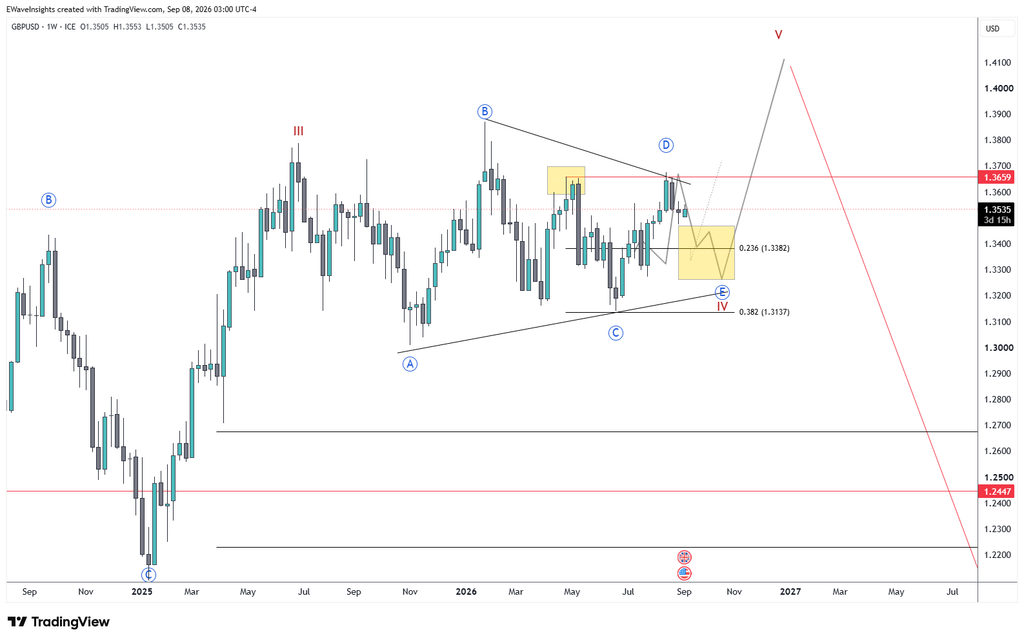
This GBPUSD Elliott Wave analysis tracks the Primary degree triangle on the weekly chart, where wave ((D)) is now complete and price is developing the final leg, wave ((E)), lower before the triangle resolves.
Bias: Bullish (multi-month), pending completion of wave ((E)) Last updated: 8 September 2026
GBPUSD weekly, Elliott Wave Insight. Wave ((D)) complete, wave ((E)) developing inside the triangle.
Why GBPUSD Is a Different Kind of Chart
GBPUSD has been building the same Grand Supercycle degree triangle since 1971, and the current leg, Cycle wave IV, has been forming since June 2025. That’s a long enough timeline that a single snapshot goes stale fast, so this page is kept current as the structure develops rather than written once.
Current GBPUSD Elliott Wave Count
- Grand Supercycle: ((a))-((b))-((c))-((d))-((e)) triangle from 1971
- Supercycle: (a)-(b)-(c) of Grand Supercycle wave ((d)), currently unfolding wave (a)
- Cycle: I-II-III-IV-V from 2022, currently in wave IV, part of Supercycle wave (a)
- Primary: ((A))-((B))-((C))-((D))-((E)) triangle forming Cycle wave IV, started 30 June 2025, with wave ((D)) now complete
- Intermediate/Minor: wave ((E)) developing as a corrective leg lower on the weekly chart
Cycle wave III completed its advance, and the market has spent the time since building out a Primary degree triangle for Cycle wave IV, underway since late June 2025. Triangles unfold in five overlapping legs labelled ((A)) through ((E)), and four of those five legs are now in place. Wave ((E)) is the last piece: a corrective dip that keeps the price action inside the triangle’s boundary lines before the structure resolves. Once Cycle wave IV completes, the next leg higher, Cycle wave V, is expected to complete the larger Supercycle wave (a) within the multi-decade Grand Supercycle triangle, so this triangle is a pause within a much longer-running structure rather than a standalone pattern.
A reliable GBPUSD Elliott Wave count like this one also has to satisfy the standard Fibonacci retracement relationships between its legs, alongside the guideline of alternation, which says wave ((B)) and wave ((D)) in a triangle should look different in shape and depth from each other. Both hold up here: wave ((D)) retraced a smaller portion of wave ((C)) than wave ((B)) did of wave ((A)), which is typical of a contracting triangle and adds confidence to labelling the current dip as wave ((E)) rather than the start of something larger.
Key Levels
| Level | Price | Why It Matters |
|---|---|---|
| Key Resistance | 1.3659 | Upper boundary of the triangle. A weekly close above this would suggest wave ((E)) has already bottomed. |
| Key Support | 1.3382 | 0.236 retracement of the wave ((D)) advance. First area where wave ((E)) could find support. |
| Invalidation | 1.3137 | 0.382 retracement. A sustained break below here would call the current triangle count into question. |
| Next Target | Above 1.3900 | Projected area for the Cycle wave V advance once wave ((E)) and the triangle complete. |
What This GBPUSD Elliott Wave Count Means for Traders
While wave ((E)) is still developing, expect choppy, overlapping price action inside the 1.3137 to 1.3659 range rather than a clean directional move; that overlap is itself a signature of triangle waves. The bigger picture stays bullish: once wave ((E)) completes, the triangle points to a Cycle wave V advance, with the triangle’s width used to project the size of that move. A weekly close back above 1.3659 would be the first sign that wave ((E)) has already found its low.
This is analysis, not personalised financial advice. Trading carries risk of loss and this page should be read alongside your own risk management.
Learn the Method Behind This Count
If terms like “triangle,” “degree,” and “wave ((E))” are new to you, our Elliott Academy breaks down the rules from first principles: start with What Are Elliott Wave Degrees? or go straight to how triangle patterns behave in their final leg. For the underlying theory itself, Investopedia’s overview of Elliott Wave Theory is a solid general reference.
Get the Full Picture
This page reflects the public summary of our GBPUSD Elliott Wave analysis. EWI members get the complete Primary and Intermediate degree breakdown, live price alerts on the key levels above, and daily updates across 30 tracked markets. See Premium →
GBPUSD Elliott Wave Analysis continues to favour a bullish higher‑timeframe roadmap, with price currently working through what looks like a higher‑degree Wave 2 correction after the impulsive advance from the 1.21 area into the 1.37s. The decline from the Wave 1 high into 1.3145 forms the first leg of the correction (w), followed by an overlapping recovery into 1.3725 as x, and price now appears to be developing the final zigzag down in y toward the 1.29–1.28 support region highlighted on the chart.

Key Levels
The primary Wave‑2 downside zone spans from roughly 1.2930, which aligns with the 0.5 retracement of the prior advance, down to around 1.2740, where the 0.618 retracement comes in. The 1.29 handle sits in the middle of this cluster and also coincides with a 1.618 Fibonacci projection of the earlier swing, creating a strong confluence area for a corrective low. As long as GBPUSD holds above the wider 1.2660–1.27 region, the larger impulsive structure from 1.21 remains intact and this correction is still best viewed as Wave 2 rather than the start of a more bearish sequence.
Elliott Wave Roadmap
The preferred roadmap is for price to fade lower from the current descending channel resistance (blue trendline) and complete Wave 2 inside the 1.29–1.28 support box before a fresh Wave 3 advance has room to develop. While that zone has not yet been tested, pops within the channel are treated as corrective rallies, not yet the beginning of Wave 3. Once the boxed area is tagged and defended ideally with evidence of impulsive buying and improving momentum the focus shifts to confirming that Wave 3 is underway, with higher‑timeframe targets then projected using standard Fibonacci extensions of Wave 1.
EURUSD Elliott Wave Analysis continues to favor a bullish higher timeframe bias while the Wave 4 contracting triangle structure holds above the base channel. Price action has likely completed wave d of the triangle, and the current focus is on wave e developing lower into the key Fibonacci support cluster at the 0.382, 0.5, and 0.618 retracement levels. This zone is where the correction is expected to complete before the next impulsive advance.
Current Structure
On the daily chart, EURUSD is tracing out a classic Wave 4 triangle, with each leg subdividing correctly and volatility compressing as the pattern matures. Wave d has tested upper resistance, and attention now shifts to wave e, which typically terminates near the triangle’s lower boundary and often aligns with Fibonacci supports taken from the prior Wave 3 advance. This confirms the integrity of the EURUSD Elliott Wave Analysis and keeps the broader uptrend intact.

4‑hour view: identifying waves ((c)) and ((d))
On the 4‑hour timeframe, the EURUSD Elliott Wave analysis marks wave ((c)) completing at 1.14697 after a sharp three‑wave decline that tagged both the lower triangle line and roughly the 0.764 retrace of the prior advance.
From that low, EURUSD advanced in another overlapping three‑wave move and topped at 1.16823 just beneath the descending triangle resistance and close to the 0.5–0.618 retracement zone, a typical termination area for a triangle’s ((d)) leg.
Momentum adds weight to this reading: while price made a marginal new high into 1.16823, 4‑hour RSI failed to register a new high, leaving mild bearish divergence against resistance.
This loss of upside momentum at a key confluence zone fits better with a maturing triangle wave ((d)) than with the start of a sustained impulsive breakout.

Key Levels & Invalidation
The key downside levels for wave e are the 0.382, 0.5, and 0.618 Fibonacci retracements, forming the primary support zone where the Wave 4 triangle is expected to complete. Invalidation of this scenario occurs only on a sustained break below the triangle floor and the base channel, which would suggest that Wave 4 is morphing into a deeper correction rather than a contained triangle. As long as price respects these structural boundaries, the bullish roadmap remains the preferred view.
Elliott Wave Roadmap
- Wave 4 triangle structure is unfolding as expected
- Wave e is projected into the 0.382–0.618 Fibonacci support cluster
- Count stays valid while price trades above the base channel and triangle support
- A clean impulsive breakout from the triangle would signal Wave 5 in progress
- Wave 5 target is the classic triangle thrust objective around 1.20697
Clear structure = clear decisions.
USD/JPY: Multi-Timeframe Elliott Wave Setup – From 4H to Weekly
This is a beautiful multi-timeframe structure. Let me walk you through the setup layer by layer.
4-Hour Chart: Wave ((C)) of D – UsdJpy Ending Diagonal
The 4-hour shows the immediate action. We’re in the final wave of this corrective leg with an ending diagonal pattern (wave C of D). Notice the converging trendlines and overlapping waves – classic diagonal structure.
Key Points:
- Wave C of D looks nearly complete around current levels (154,452)
- The red dashed line is your confirmation trigger – a break below this line signals the ending diagonal is finished and we’re moving into pullback/wave E setup
- “Waiting for Break-Out” label shows we’re right at the edge
- Support zones marked: 0.618 (153.606), 0.382 (149.266), 0.5 (147.482)
What to watch: Break of the red dashed line = Wave C complete, pullback incoming.

Daily Chart: Full Wave D Structure
Zooming out to the daily, we see the complete wave D structure that contains the 4-hour action. This is the corrective triangle (wave D) within the larger wave 4.
Key Points:
- Wave A, B, C, D all visible in a triangle pattern
- We’re near D completion (which contains our 4-hour wave C)
- Wave E is the final leg of this correction coming next
- The triangle is converging toward E – which should be a smaller, final bounce

What this means: When the 4-hour breaks that red line, we get wave E on the daily. Wave E should be tight, contained, and smaller than the prior legs – classic triangle behavior.
Weekly Chart: Wave (4) – The Giant Triangle
Now pull back to the weekly, and you see the massive wave 4 correction that everything fits inside. This is the big picture context.
Structure:
- Wave A, B, C, D, E = the full wave 4 correction on the weekly
- We’re currently in D phase of this macro correction
- After D completes (after wave E on the daily), we get the powerful wave 5 impulse on the weekly

The Trade Setup:
- 4-hour: Wave C breaks red line → Pullback to 0.618 (153.606)
- Daily: Wave E unfolds → Smaller bounce in the E zone (151,000-143,000 range)
- Weekly: After E completes → Major impulse wave 5 begins with strong directional move
Why This Matters
This isn’t just a reversal. You’re watching a corrective structure complete at multiple timeframes simultaneously. When wave D finishes and wave E plays out, you’ll have:
- Confirmed structure (4-hour break + daily pattern completion)
- Clear pullback zones (Fibonacci levels marked)
- Setup for the strongest move (weekly wave 5 impulse incoming)
Trading Action: Wait for 4-hour red line break → Confirm pullback to daily support → Position for wave 5 breakout. This is where the money is.
Want Next Week’s Elliott Setups First?
Subscribe below to get premium analysis, early trade signals, and the latest strategy updates direct to your inbox.
Get Exclusive Updates
Already a member? Log in here | Free Discord Join our Discord room
Disclaimer
Primary Count: Wave (2) correction in progress, forming a classic “Flat” correction pattern. Currently consolidating in the 200.806–201.228 range.
Wave Count Invalidation: @200.899

4HR Chart

15 Min Chart
Primary Count: Wave (2) correction in progress, forming a classic “Flat” correction pattern. Currently consolidating in the 200.806–201.228 range.
Want Next Week’s Elliott Setups First?
Subscribe below to get premium analysis, early trade signals, and the latest strategy updates direct to your inbox.
Get Exclusive Updates
Already a member? Log in here | Free Discord Join our Discord room
Disclaimer
GBPJPY Elliott Wave analysis has presented a compelling Elliott Wave setup, and our recent analysis predicted a converging triangle pattern that would lead to a significant drop. This post documents our forecast, the price action that followed, and the key lessons for traders using Elliott Wave methodology.
Recent Twitter Posts on GBPJPY
These charts reveal precise Elliott Wave labelling, Fibonacci retracement levels, and critical support/resistance zones across each timeframe.


GBPJPY Monthly Chart
Showing the bigger picture for our sell targets
The monthly timeframe Elliott Wave count suggests we are currently trading within a complex triangle structure in wave (E), which is likely to target the 0.618 (192.422) and 0.764 (189.401) Fibonacci levels shown on the chart below. This long-term perspective provides strong conviction in our directional bias and profit targets.

On the 4-hour timeframe, price action has progressed exactly as our Elliott Wave count predicted. Wave (3) is currently driving lower toward the 1.618 extension at 197.339, with a deeper target at the 2.618 extension at 193.670.

#GBPJPY 4H: #TrianglePattern Forming
— Elliott Wave Insights (@EWaveInsights) October 27, 2025
Clear Elliott Wave structure shows a converging triangle pattern developing
as wave (4) correction.
Key Levels:
? Upper Triangle: Wave C 204.06
? Lower Triangle: Wave B 201.93
? Wave (5):Target 200.03#ElliottWave #ForexTrading pic.twitter.com/iHnAen90wX

Want Next Week’s Elliott Setups First?
Subscribe below to get premium analysis, early trade signals, and the latest strategy updates direct to your inbox.
Get Exclusive Updates
Already a member? Log in here | Free Discord Join our Discord room
Disclaimer